


Is Oracle’s AI Backlog Hiding a More Complicated Capital Story?
Oracle’s recent chart behavior suggests that investors are trying to weigh two very different stories at once. On one side is an expanding AI backlog and a renewed role in the data-center buildout; on the other is a growing debate over debt, cash flow, and the long-term cost of financing that ambition.
That mix makes Oracle more interesting than a simple bullish or bearish call. The bigger question may be whether the market has fully adjusted to the capital demands behind the company’s AI push, or whether part of that story is still being absorbed.
Why Oracle’s Capital Structure Matters More in the AI Cycle?
Before the current AI infrastructure race, Oracle was often viewed as a slower-moving legacy technology company rather than a central player in the next phase of data-center investment. Its re-emergence in the AI narrative has changed that perception, particularly as its backlog points to stronger revenue potential and a bigger role in enterprise infrastructure.
At the same time, the funding side of that expansion has become harder to ignore. Oracle continues to add debt and issue shares to raise capital, which changes the way investors think about earnings per share, valuation, and the balance between long-term opportunity and financing pressure. In that sense, dilution risk is not a side issue but part of the broader question around how sustainable Oracle’s AI expansion really is.
Top Regulated Brokers
What Oracle’s Price Action and Fundamentals Are Showing
Oracle’s chart appears to reflect concern over rising debt levels, but it is less clear whether the current price fully captures the added risk from pending equity issuance. Part of the recent weakness may simply reflect the broader re-pricing across AI-linked stocks, yet Oracle’s capital structure gives investors a more company-specific issue to evaluate.
The underlying question is how a valuation adjustment might interact with shareholder dilution if financing needs remain elevated. That matters because Oracle’s AI narrative still has support in the form of backlog growth, but the market now seems more focused on what it costs to fund that growth than on the story alone.
Metric | Value | Verdict |
P/E Ratio | 25.43 | Bullish |
P/B Ratio | 11.39 | Bearish |
PEG Ratio | 0.84 | Bullish |
Current Ratio | 1.12 | Bearish |
Return on Assets | 6.50% | Bearish |
Return on Equity | 53.38% | Bullish |
Profit Margin | 25.37% | Bullish |
ROIC-WACC Ratio | Negative | Bearish |
Dividend Yield | 1.35% | Bearish |
Oracle Fundamental Analysis Snapshot
Price action remains inside a bearish channel, and average bearish trading volume continues to exceed bullish participation, which suggests the market is still leaning cautiously. At the same time, the Bull Bear Power Indicator remains bearish but shows a positive divergence, hinting that downside momentum may be losing some force even if conviction has not clearly shifted. This creates a setup where price behavior looks less like panic and more like an ongoing reassessment of how much risk should be attached to Oracle’s current expansion strategy.
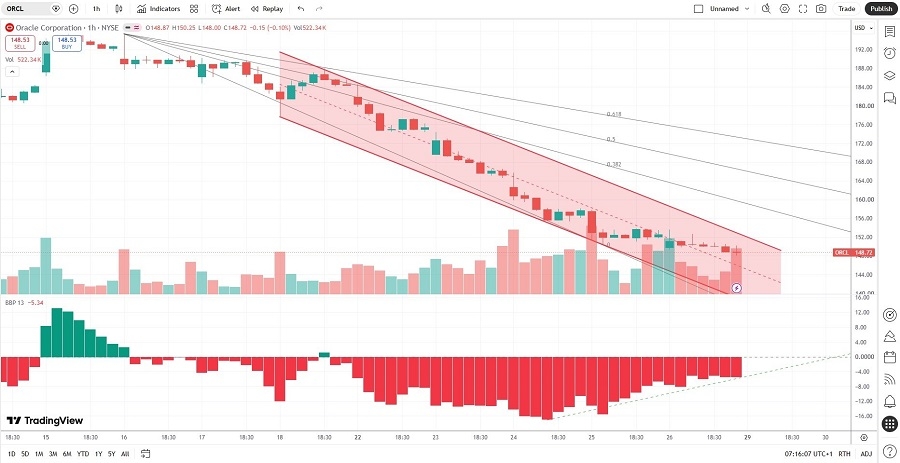
Oracle Price Chart
Underappreciated Risks in Oracle’s AI Expansion Story
Oracle’s AI-related backlog of $638 billion is substantial, but the market appears increasingly focused on how that opportunity is being financed. The company’s close relationship with OpenAI was once viewed mainly as a bullish signal, yet sentiment around that relationship has become more complicated after NVIDIA materially reduced its investment and OpenAI’s IPO timeline became less certain. These factors do not invalidate Oracle’s AI role, but they do make the broader ecosystem look less straightforward than it did earlier in the cycle.
The higher-for-longer rate backdrop adds another layer of friction. With Oracle reporting nearly $24 billion in negative free cash flow in its latest fiscal year, plus plans to raise $20 billion in debt in fiscal 2027 alongside an additional $20 billion share sale, investors are increasingly forced to weigh backlog strength against financing strain. The blind spot may not be Oracle’s AI demand itself, but the market’s assumption that capital markets will remain equally supportive if execution becomes more expensive.
How Analysts Still Frame Oracle’s Upside Potential
Despite the correction, the average analyst price target of $252.64 still implies notable upside potential. That suggests many analysts continue to believe Oracle’s revenue opportunity in AI infrastructure can outweigh concerns about capital intensity and dilution.
Even so, the current setup still depends on Oracle showing that its 2027 capital expenditure plans, expected income generation, and balance-sheet trajectory can fit together more comfortably than the market currently assumes. If Oracle can demonstrate a credible path back toward stronger cash generation, the current caution may look excessive. If not, financing pressure could remain a central part of the valuation debate.
What to Watch Next for Oracle?
Oracle continues to trade between its descending 0.0% and 38.2% Fibonacci Retracement Fan levels, with the broader bearish channel still shaping sentiment. The $148.00 and $153.55 areas may offer useful technical reference points, but the more important question is whether upcoming developments change how investors interpret Oracle’s capital demands relative to its AI opportunity.
The next phase for the stock is likely to depend less on a single headline and more on whether debt growth, equity issuance, backlog conversion, and cash-flow expectations begin to move into better alignment. That balance remains unresolved, which is exactly why Oracle’s setup continues to attract attention.
Ready to trade our analysis of Oracle? Here is our list of the best stockbrokers worth reviewing.