


Is NVIDIA’s B200 Pricing Shift Revealing a Deeper Crack in the AI Infrastructure Trade?
NVIDIA sits at the center of the US AI infrastructure story, yet its recent price behavior feels less straightforward than the headlines surrounding it. The company continues to deliver top‑tier hardware, but questions around how that compute power is priced are starting to challenge earlier assumptions about demand and profitability.
Top Regulated Brokers
Rather than offering a simple “overvalued vs undervalued” verdict, the current setup suggests a market trying to decide how much risk is already reflected in the chart and how much remains hidden beneath the enthusiasm. That tension between narrative strength and emerging doubts is what makes today’s NVIDIA backdrop worth a closer look.
Why B200 compute pricing matters
The massive investments in research and development required to keep NVIDIA’s technology at the top of the AI stack must ultimately translate into revenue streams that justify those capital expenditures. Over the past month, investors have begun to question whether the scale of AI spending that dominated headlines over the last year is still necessary and economically comfortable at current valuations. This reassessment does not directly challenge the importance of AI, but it does probe how efficiently that infrastructure is being built and priced.
China’s experience has added another layer to the debate, with cheaper models reportedly capable of handling a large share of everyday AI workloads at lower cost and faster turnaround than premium options powered by NVIDIA chips. Against that backdrop, developments in B200 compute pricing have moved from a technical detail to a focal point in the NVIDIA narrative. The shift raises questions about how hyperscalers and other large customers will balance performance, price, and scale, and how much flexibility NVIDIA really has in defending its own margin profile as conditions evolve.
NVIDIA facts worth considering today
NVIDIA’s chart shows that investors have already responded to a series of bearish themes, with price action descending inside a well‑defined bearish channel. Trading volumes reflect that pressure, as average bearish volume has outpaced bullish interest in recent sessions. At the same time, the Bull Bear Power Indicator remains in bearish territory, but a positive divergence has formed, hinting at a more complex balance between sellers and buyers than a simple one‑direction move.
Metric | Value | Verdict |
P/E Ratio | 29.48 | Bullish |
P/B Ratio | 23.86 | Bearish |
PEG Ratio | 0.59 | Bullish |
Current Ratio | 3.44 | Bullish |
Return on Assets | 52.73% | Bullish |
Return on Equity | 114.29% | Bullish |
Profit Margin | 62.97% | Bullish |
ROIC-WACC Ratio | Positive | Bullish |
Dividend Yield | 0.52% | Bearish |
NVIDIA Fundamental Analysis Snapshot
This combination suggests that the market is not ignoring risk, but it may still be working through how to weigh recent developments against longer‑term growth expectations. One key question is whether the current chart already reflects the more than 30% contraction in B200 compute pricing, or whether that adjustment is only partially processed. Headlines about multi‑billion‑dollar AI infrastructure investments, including NVIDIA’s own exposure to companies that would ultimately buy its chips, have also fed a narrative about circular financing that some investors continue to scrutinize. The chart behavior therefore appears to capture both rising skepticism and ongoing confidence, producing a setup where short‑term swings may say as much about sentiment calibration as they do about a decisive shift in fundamentals.
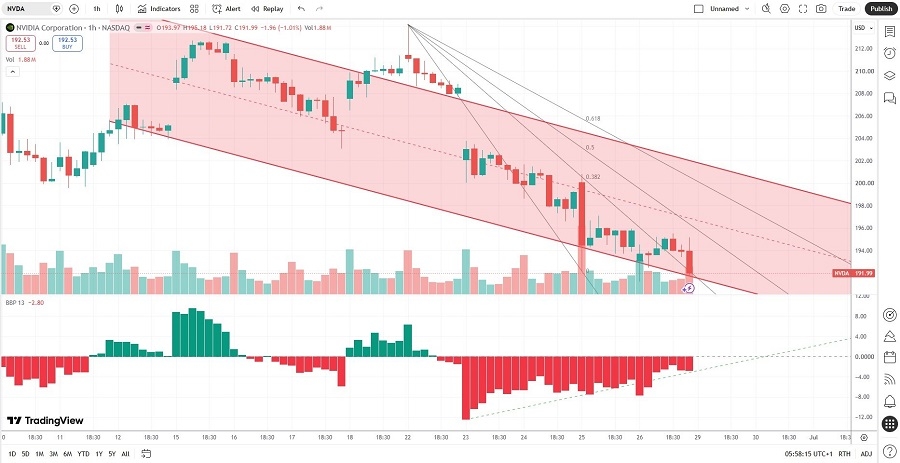
NVIDIA Price Chart
Some underappreciated facts about NVIDIA
One underappreciated element in the current NVIDIA story is the change in rental pricing for its flagship B200 GPU, where the hourly rate has declined more than 30% within a month, from $6.11 to $4.22. On its own, this does not prove that the AI buildout cycle has peaked, but it does suggest that customers are pushing harder on cost and efficiency, and that pricing power may be more flexible than earlier assumptions implied. If demand remains strong but average pricing softens, the market will need to reconcile lofty expectations for revenue and margin with evolving commercial realities.
Broader macro factors add to this friction. High inflation data creates a backdrop where valuation compression risk is already elevated, and any perception that premium compute is becoming less differentiated could amplify that pressure. NVIDIA also faces questions around its reduced investment in OpenAI and notable underperformance relative to the VanEck Semiconductor ETF (SMH), which together point to a more nuanced relationship between company‑specific momentum and sector‑wide flows. The risk may not be a sudden collapse, but a gradual recalibration of how investors value NVIDIA’s role in the AI ecosystem if these trends persist.
One layer under today’s NVIDIA setup
Despite the correction, the average analyst price target of $300.59 still points to some attractive upside potential in the eyes of many market observers. That view assumes that NVIDIA’s positioning in AI hardware and infrastructure remains durable, and that current pricing adjustments will ultimately be seen as part of a normal cycle rather than a structural break. If B200 rental rates stabilize and demand for high‑end compute proves resilient, the recent drawdown could be interpreted as a reset that brings valuations back into a range more consistent with long‑term growth and profitability.
At the same time, a sustained period of lower pricing or slower infrastructure spending would challenge that thesis and invite further reassessment. The key issue is not whether a single indicator “calls the top,” but how multiple factors—pricing, sector flows, and macro data—combine to shape the trajectory investors assign to NVIDIA over the next phase of the AI cycle.
What’s next for NVIDIA?
For now, NVIDIA trades between its descending 38.2% and 50.0% Fibonacci Retracement Fan levels inside a bearish price channel, with rising bearish volumes and pockets of positive divergence signaling an unsettled balance between caution and interest. Valuation metrics still suggest a discount relative to some peers, which adds another dimension to monitor as the story develops.
The levels around $191.72 and $197.13 may offer useful reference points, but the more important signals are likely to come from how B200 pricing evolves, how AI workloads shift between premium and lower‑cost models, and how sector flows respond to new data. The coming sessions should clarify whether the current phase is a pause within a broader trend or the start of a more extended adjustment.
Ready to trade our analysis of NVIDIA? Here is our list of the best stockbrokers worth reviewing.