


Is Meta’s Current Valuation Hiding a Stronger AI Monetization Story?
Meta Platforms (NASDAQ:META) has corrected alongside the broader AI leadership group amid sector rotation and concern over capital expenditures, but the current setup may also point to a more nuanced valuation story than the headlines suggest.
Top Regulated Brokers
Current sentiment still appears heavily shaped by concerns over AI competition, hardware spending, and regulatory scrutiny, yet several underlying business developments may not be fully reflected in how the shares are being priced.
Why Meta’s Current Valuation and AI Strategy Matter Now
Valuation on its own is only one metric among many, but when it is considered alongside recent price action and fundamental developments, it can reveal whether a stock is being viewed too narrowly. Many AI-focused companies still trade on ambitious expectations, yet Meta Platforms appears to offer a different mix: a large established advertising business, expanding monetization channels, and a valuation profile that looks less stretched than some of its peers. That combination helps explain why META may be attracting attention as a potentially mispriced part of the AI leadership group.
More interesting than price alone is how investors respond when a stock faces both strong bullish arguments and persistent skepticism at the same time. Trading volumes and recent chart behavior suggest sentiment may be shifting at the margin, even if that change remains tentative.
What Meta’s Recent Price Action and Fundamentals Are Showing
Meta Platforms appears to be showing early signs of a sentiment shift as a number of bullish catalysts, which have received less attention than broader AI concerns, continue to accumulate. The key question is whether those catalysts are strong enough to change how the market interprets the current support zone and the broader correction.
Metric | Value | Verdict |
P/E Ratio | 20.00 | Bullish |
P/B Ratio | 5.73 | Bearish |
PEG Ratio | 0.80 | Bullish |
Current Ratio | 2.35 | Bullish |
Return on Assets | 16.40% | Bullish |
Return on Equity | 32.93% | Bullish |
Profit Margin | 32.84% | Bullish |
ROIC-WACC Ratio | Positive | Bullish |
Dividend Yield | 0.38% | Bearish |
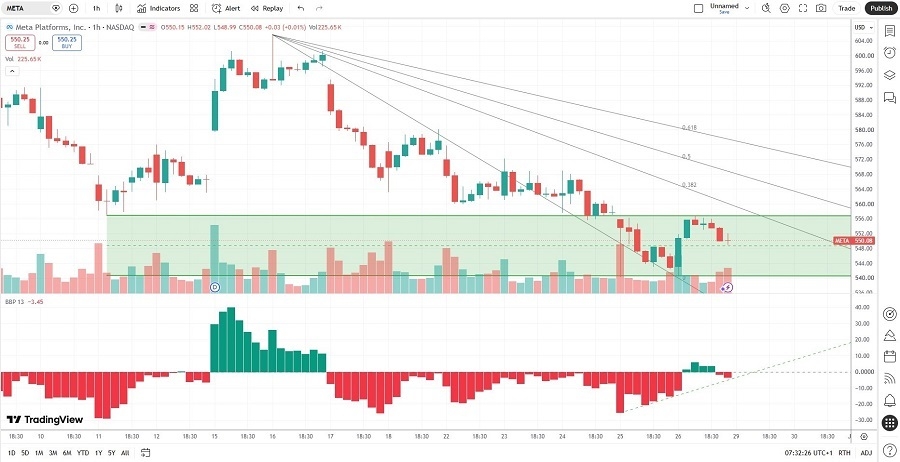
Price action has entered a meaningful horizontal support zone, and average bullish trading volumes are higher than average bearish volumes, even though bearish periods still outnumber bullish ones. The Bull Bear Power Indicator remains bearish, but its ascending trendline suggests downside pressure may be easing rather than intensifying, a subtle shift that deserves attention.
Underappreciated Drivers and Risks in Meta’s AI Monetization Story
Meta Platforms has corrected alongside the broader AI sector, and while bearish sentiment still dominates, the chart points to easing downside pressure at the same time that several core fundamental factors have strengthened. The company has underperformed peers such as Microsoft and NVIDIA, which makes the disconnect between its operating profile and current share price more notable. Rather than simply treating META as another AI trade, the market may be underestimating how much support still comes from its diversified revenue stream and improving monetization channels.
Much of the bearish focus remains on Meta Platforms' $125 to $145 billion in capital expenditure guidance, yet that attention may understate the significance of positive AI monetization developments already taking shape. Business AI Messaging, Meta One Subscriptions, and the most recent quarter's 33% revenue surge, alongside a 12% increase in average price per ad, all suggest the business is finding ways to translate AI investment into commercial results.
How Analysts Currently Frame Meta’s Upside and Uncertainty
Despite the ongoing correction, the average analyst price target of $827.32 still points to attractive upside potential. The absence of sell recommendations against 57 buy recommendations also supports the view that sentiment may be more cautious than outright negative. Even so, Meta Platforms still needs to show that its value proposition, heavy capital spending, and AI strategy are aligned in a way that can justify investor confidence over time. The next earnings release may therefore matter less as a one-day catalyst and more as a test of whether recent monetization progress is strong enough to support the broader thesis.
What to Watch Next for Meta’s Share Price and AI Strategy
Price action is trading between its descending 0.0% and 38.2% Fibonacci Retracement Fan levels, and the first attempt to move above the horizontal support zone has failed. The $557.01 level may offer an important clue as to whether sentiment is beginning to improve, while a move below $540.40 would suggest that caution still dominates. More broadly, the next phase for Meta Platforms will likely depend on whether investors continue to focus primarily on capital spending, or begin to give more weight to monetization, advertising strength, and the company's ability to turn AI investment into durable revenue growth.
Ready to trade our analysis of Meta? Here is our list of the best stockbrokers worth reviewing.