

Need to swap large amounts of crypto without KYC? Compare the best high-volume exchanges with no limits in 2026 — including a live 10 BTC scenario across 5 platforms.
Most exchanges will process your $200 swap without blinking. Try moving $50,000 worth of Bitcoin, and the experience changes fast — identity verification requests, transaction holds, and in some cases, account freezes. The infrastructure of centralized exchanges was built for retail. High-volume traders are increasingly an afterthought, or a compliance liability.
This piece is for traders who need to move real size — and want to understand exactly where the friction appears, which platforms avoid it by design, and what an actual large swap looks like across five different exchanges.
What Actually Triggers KYC on a Crypto Exchange?
KYC is triggered not just by account thresholds, but by specific transaction patterns that compliance systems flag automatically.
Most traders assume KYC kicks in at a fixed dollar amount. The reality is more granular. Here are the most common triggers observed across centralized and hybrid platforms:
- Single transaction value exceeding platform thresholds (commonly $1,000–$10,000 depending on jurisdiction)
- Cumulative daily or monthly volume crossing internal limits — even across small transactions
- Destination wallet analysis — if your receiving address has prior flags in chain analytics tools (Chainalysis, Elliptic), some platforms will pause your swap automatically
- Unusual asset pairs — swapping into privacy coins (XMR, DASH, ZEC) on otherwise KYC-light platforms often triggers enhanced review
- IP or device mismatches — new device, new country, large transaction = elevated risk score
- Velocity patterns — three $9,500 swaps in 48 hours will often trigger the same response as a single $28,500 swap
Understanding these triggers matters because avoiding KYC isn't just about choosing the right platform — it's about understanding what architecture a platform uses to process your transaction.
Paper Swap: What Happens When You Try to Move 10 BTC Across 5 Exchanges?
A hypothetical 10 BTC swap (~$950,000 at current prices) reveals exactly where each platform's limits and friction points lie.
We modeled a swap of 10 BTC → USDT across five platforms. This is a "paper swap" — a structured comparison using publicly available terms, stated limits, and documented platform behavior, not live execution.
At a Glance: 10 BTC Swap Comparison
Platform | Type | KYC Required | Stated Limit | 10 BTC Outcome | Est. Fee Model |
Non-custodial instant | No KYC | No upper limit | ✅ Processes without friction | Spread-base d, transparent | |
BasicSwap | Self-hosted P2P protocol | None by design | Counterparty- matched | ⚠ Requires local node setup; not a web service | No platform fee |
RetoSwap | P2P fiat↔XMR marketplace | Fiat identity exposed to peer | Peer-matche d | ❌ Fiat-to-XMR only; no crypto-to-cryp to path | 0.6% platform fee |
Crypton Exchange | Centralized (privacy-focu sed) | No KYC (registration required) | Not stated | ⚠ Account required; real name collected at signup | Maker/taker spread |
Platform | Type | KYC Required | Stated Limit | 10 BTC Outcome | Est. Fee Model |
BitcoinVN | Regional CEX + OTC (Vietnam) | Full KYC + automated screening | Tiered by verification | ❌ Requires verified account; automated AML system active | Fixed % fee |
What this table shows: Non-custodial instant exchanges (Godex) are the only architecture that handles a 10 BTC swap without routing your transaction through a compliance layer. The other no-KYC options exist, but serve fundamentally different use cases — as the breakdown below makes clear.
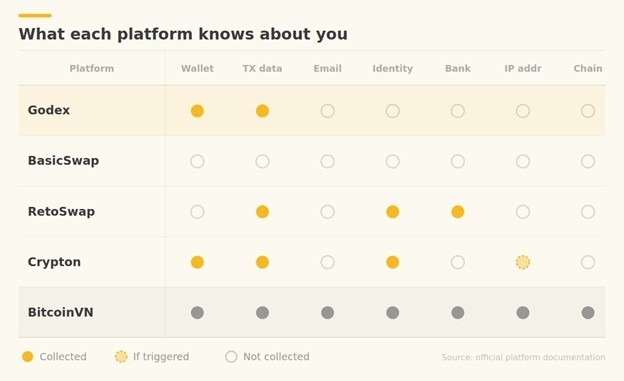
Matrix showing what personal data five crypto exchanges collect: Godex collects only wallet address and transaction data; BasicSwap collects nothing; RetoSwap collects transaction data, identity, and bank details; Crypton collects wallet, transaction data, and identity; BitcoinVN collects all seven data categories including chain analytics.
Godex
Godex processes the swap against its liquidity layer without ever taking custody of the funds — no account created, no identity checked, no order sitting in a visible book waiting to be matched. The fixed rate option locks pricing at initiation, which matters at this size: a 0.5% rate shift during a 10-minute confirmation window on a $950,000 swap is a $4,750 variance.
- No KYC at any volume: Only wallet addresses and tx hashes collected — no ID, no selfie.
- Fixed rate locks pricing at order creation — eliminates confirmation-window exposure on large amounts.
- No custody event = no AML trigger, regardless of swap size.
BasicSwap
Its terms state explicitly that it does not process, execute, or initiate swaps on users' behalf — the respective blockchains do. The tradeoff is significant: BasicSwap isn't a website you visit. It's a protocol you self-compile, install on a local device, and run as a network node. There's no web interface. For a trader wanting to move 10 BTC quickly, this is a different product category — not a slower version of the same product.
- Setup requires manual compilation, blockchain sync, and a live SMSG node — no web interface.
- No liquidity pool — a 10 BTC fill depends on a willing counterparty at your price.
- No fees, no custody, no entity that can be compelled to freeze or report.
RetoSwap
RetoSwap is genuinely privacy-focused, but in a specific direction. It's a fiat-to-XMR marketplace: to trade, both parties must have real bank account details on file that match their actual accounts. Your XMR wallet stays private; your fiat identity is visible to your counterparty. The platform's own trading rules flag the fiat banking risk directly, noting that payment references must never mention Monero or crypto — because many banks will take punitive action if they detect such transactions.
- Real bank details required — fiat identity is visible to your counterparty by design.
- No native path for BTC → USDT — all pairs are built around buying or selling Monero.
- Complex disputes involve a human arbitrator and can take weeks to resolve.
Crypton Exchange
Crypton's terms are explicit: "Regardless of the transaction's amount and cryptocurrency used, we will never ask a client to go through the KYC process." The no-KYC guarantee is
policy-based rather than architectural — Crypton is a custodial, account-based exchange. To use it, you register with your first and last name and a Utopia Public Key. No email, no government ID, no identity verification — but your real name is on file. For a 10 BTC → USDT swap, the practical limitation isn't compliance friction: it's that Crypton is built around its native CRP token and USDT, with a narrower asset scope than generalist instant exchanges.
- No KYC ever, by explicit policy — confirmed regardless of amount or asset.
- Registration requires your real name — first/last name and Utopia Public Key collected at signup.
- Custodial and account-based — a compliance hold or account freeze remains possible despite the no-KYC commitment.
BitcoinVN
BitcoinVN is a fully regulated entity operating legitimately in Southeast Asia. Its KYC/AML policy discloses an automated risk prevention system that screens every transaction — if flagged, the exchange is paused for individual compliance review. The platform also shares transaction data with blockchain analytics providers and retains account information indefinitely. Its Terms of Service explicitly prohibit using the service to break the connection between sending and receiving addresses.
- Automated AML screening on every transaction — trigger criteria are undisclosed by design.
- Transaction data shared with chain analytics providers; account data retained indefinitely.
- Built for verified OTC clients — different product, different user entirely.
How Does OTC Compare for Large Crypto Swaps?
OTC desks offer negotiated pricing and relationship-based service for large trades, but they universally require identity verification and are subject to institutional compliance obligations.
OTC (over-the-counter) trading is often positioned as the "sophisticated" alternative for high-volume swaps. Here's what that actually means in practice:
OTC advantages:
- Negotiated rates on large blocks (can beat exchange spreads at $500K+)
- White-glove settlement, often with dedicated account managers
- Reduced slippage vs. thin order books
OTC disadvantages:
- Full KYC/AML is non-negotiable — institutional desks operate under the same frameworks as banks
- Minimum ticket sizes typically start at $50,000–$100,000
- Counterparty risk exists until settlement
- Not suitable for recurring, automated, or privacy-sensitive swaps
The honest comparison:
OTC is a better product than an exchange for traders who need size and are already KYC-verified. If you're optimizing for anonymity or operational speed, OTC removes both. It's a different use case, not a better one.
For traders who want to swap large amount crypto without entering a compliance pipeline, the non-custodial instant exchange model is functionally the only option that scales.
What Makes a Crypto Exchange Truly Unlimited?
A "no-limits" exchange is one where transaction size is constrained only by liquidity and network conditions — not compliance thresholds or identity tiers.
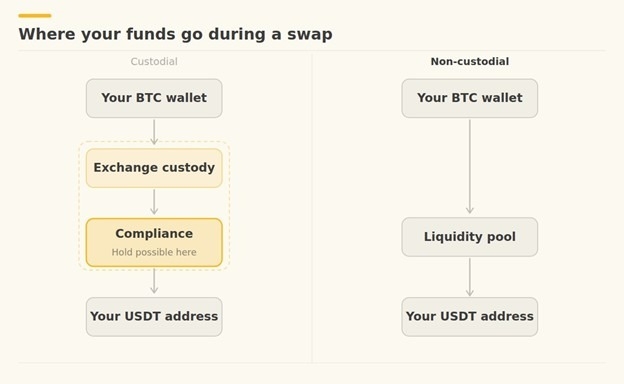
Diagram comparing where funds go during a custodial vs
non-custodial crypto swap: custodial path routes BTC through exchange custody and compliance screening before reaching the USDT address; non-custodial path routes directly through a liquidity pool with no custody step.
The phrase "no KYC" is thrown around loosely. These are the architectural attributes that actually determine whether a platform can process unlimited crypto swaps:
- Non-custodial design — your funds never touch the exchange's wallet. The platform facilitates the swap; it doesn't hold assets. This is the core structural reason why KYC is technically unnecessary.
- No order book — instant exchanges execute against liquidity provider pools, not matched orders. This means no "large order" visibility.
- No registration requirement — no account = no account-level monitoring or flagging.
- No fiat on/off ramp — platforms that only handle crypto-to-crypto swaps avoid the bank compliance layer entirely.
Godex is a non-custodial instant crypto exchange operating since 2018 that requires no KYC, no registration, and imposes no upper limit on swap volume. It supports 937+ cryptocurrencies with both fixed and floating rate options. What it does collect is minimal by design: wallet addresses, transaction hashes, and exchange IDs — the data required to complete and support the transaction, nothing more. No passport, no selfie, no government ID. The fixed rate option is particularly useful for large swaps where price movement during processing is a real cost.
That architecture isn't a policy choice that could be reversed under pressure — it's the product. Rebuilding Godex to be custodial would require rebuilding Godex.
How to Execute a Large Swap Without KYC Triggers: Practical Checklist
The highest-risk moment in any large crypto swap is the destination wallet — not the exchange itself.
Even on a platform with no KYC, the assets land somewhere. That destination can be analyzed. Here's what experienced high-volume traders actually do:
- Choose non-custodial platforms — eliminates custody-layer risk entirely
- Use fixed-rate swaps for large volumes — locks your price at initiation, eliminates exposure to spread changes mid-swap
- Verify the receiving address before initiating — chain analytics flags can create downstream problems even when the swap itself is clean
- Avoid breaking large swaps into suspicious tranches — structuring is a recognized compliance flag; if you're splitting a large swap, do it for liquidity reasons, not to stay under thresholds
- Check destination chain fees — a 10 BTC → USDT swap on Ethereum at peak gas costs meaningfully more to settle than on Tron or Solana
- Document your own transaction — non-custodial platforms don't keep records beyond what's operationally necessary; you should keep your own
Comparing the Platforms: Final Scorecard
Criteria | Godex | BasicSwap | RetoSwap | Crypton | BitcoinVN |
No KYC | ✅ | ✅ | ✅ (crypto side) | ✅ (by policy) | ❌ |
No upper limit | ✅ | ⚠ | ⚠ | ❓ | ❌ |
Crypto-to-cry pto | ✅ | ✅ | ❌ | ✅ | ✅ |
Speed (large swap) | Fast | Requires node setup | Fiat rails dependent | Medium | Medium |
Asset variety | 937+ | Limited | XMR/fiat pairs | Moderate | Regional |
Fixed rate option | ✅ | ❌ | ❌ | ❌ | ✅ |
Best for | Large instant swaps, no friction | Maximum protocol-level privacy | Fiat → XMR specifically | CRP/USDT trading, no-KYC with registration | Regulated OTC, SEA region |
The Bottom Line
For a high-volume crypto swap without KYC, the platform architecture matters more than the stated policy.
Non-custodial instant exchanges eliminate KYC at the structural level. True P2P protocols like BasicSwap offer maximum privacy guarantees but are tools you run, not services you use.
RetoSwap serves fiat-to-XMR traders well but doesn't serve a crypto-to-crypto large swap scenario. OTC is powerful but requires identity. Regional exchanges like BitcoinVN operate with full compliance frameworks and belong in a separate category.
The key criteria for high-volume, privacy-first swaps in 2026: non-custodial design, no registration requirement, crypto-to-crypto execution, fixed-rate availability, and a liquidity layer that can absorb real size without slippage problems.
If those criteria are what you're optimizing for, Godex is worth running your next large swap through — godex.io.
All exchange terms and thresholds are subject to change. Verify current conditions before executing large transactions. This article does not constitute financial or legal advice.