


H1
Top Regulated Brokers
EUR/USD Faces Persistent Pressure as US Real Yields Rise
Metatitle
EUR/USD: Why Holding Support May Not Signal a Recovery
Metadescription
EUR/USD holds near 1.11 as rising US real yields, European energy costs and French debt concerns weigh on sentiment. What could change the outlook?
The Euro is struggling to turn periods of stability into a convincing recovery. Rallies continue to attract selling, leaving an important question unresolved: is the currency finding its footing, or simply pausing while the pressures behind its weakness remain in place?
The tension extends beyond the next move in interest rates. Rising US real yields are competing with concerns about Europe’s energy supply and unresolved debt problems. Together, these influences leave the Euro facing a difficult test of confidence, even as buyers continue to defend a familiar area of support.
Higher US Yields Complicate the Euro’s Recovery
Friday’s trading session was choppy, reflecting uncertainty about whether the Euro can regain momentum while US real yields rise sharply. Those higher yields remain a reason for traders to consider selling EUR/USD, particularly with European interest rates already below those in the United States.
The question is whether the Federal Reserve needs to maintain an exceptionally restrictive policy stance. The FedWatch pricing cited in the original analysis points to a 25-basis-point increase in December, followed by approximately a 40% probability of another increase in March.
That interest-rate backdrop presents a challenge for the Euro. A lasting recovery would be harder to establish if expectations for tighter US policy remain firm while Europe continues to face its own economic pressures. For now, the pair’s uneven trading reflects the difficulty of reconciling occasional buying interest with a broader environment that still favours selling into rallies.
EUR/USD Holds 1.11, but Rallies Still Attract Sellers
EUR/USD’s recent behaviour suggests modest underlying weakness rather than a decisive directional move. The pair continues to produce small rallies, but those advances are being met with selling.
The 1.11 level has provided significant support, preventing the weakness from developing into a clearer move lower. Its resilience matters, but holding support is not the same as demonstrating that buyers have established control. The repeated selling into rebounds leaves the recovery question open.
A break below 1.11 would bring 1.10 into focus as the next downside reference. That large, round number carries psychological significance and would likely attract considerable attention if reached.
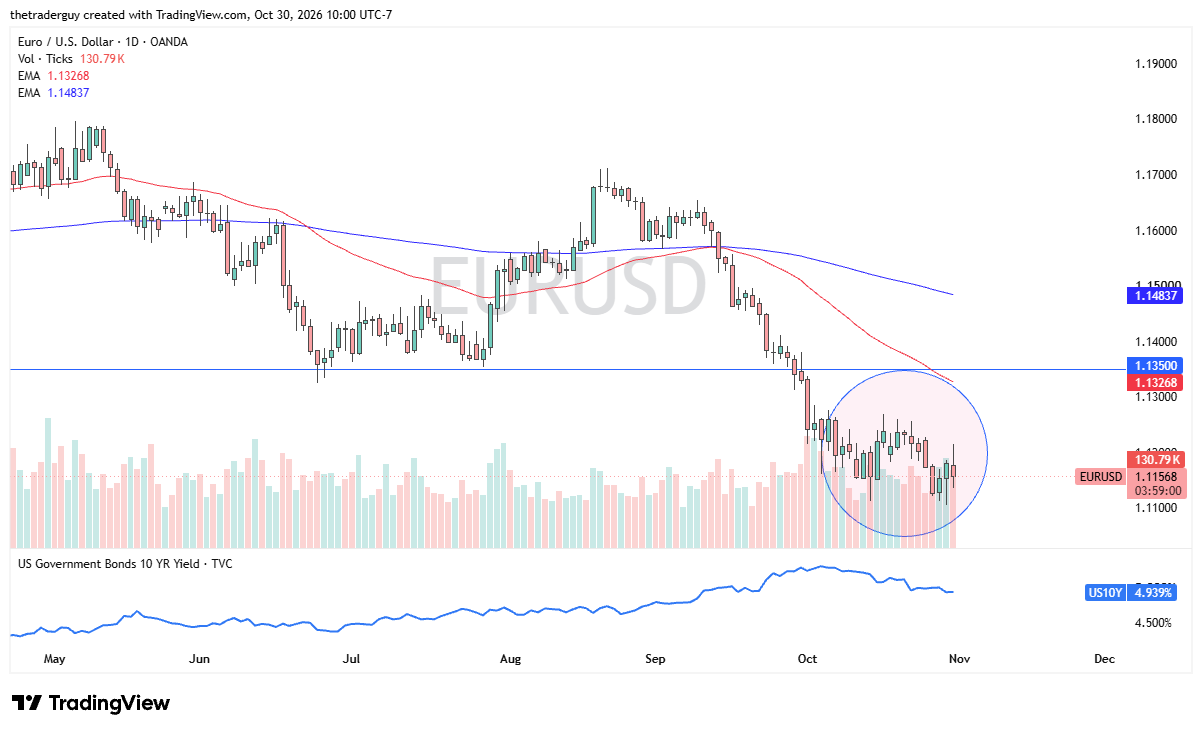 EUR/USD Price Chart
Until support gives way or rallies become more durable, the pair remains caught between a defended lower boundary and persistent selling pressure. The resulting choppiness is consistent with a market still questioning both the Euro’s prospects and the likely path of US monetary policy.
Europe’s Energy and Debt Problems Remain a Confidence Test
Interest-rate differences are only part of the Euro’s difficulty. Europe’s energy position remains a separate concern, with implications for demand for European assets and the region’s industrial outlook.
Natural gas prices for European consumers have almost quadrupled. The prospect of renewed US military action against Iran adds to the risk of further energy-related pressure. If energy availability becomes more constrained, it is difficult to see European assets attracting strong demand, while Germany’s industrial base would also face the effects.
These concerns could encourage investors to reduce exposure to Europe and, by extension, the Euro itself. They also complicate any interpretation of price stability as evidence that the currency’s underlying problems are easing.
France’s debt situation adds another unresolved pressure. It has already unsettled markets, and the absence of a clear solution leaves scope for those concerns to resurface. The risk is that a temporary lull in the headlines is mistaken for a lasting improvement.
What Could Challenge the Bearish EUR/USD View?
An alternative scenario would involve French yields coming under control alongside a meaningful easing of the country’s debt problems. That would remove one source of uncertainty surrounding European assets.
A change in the US inflation outlook could also matter. If inflation cools sufficiently to reduce pressure for higher interest rates, expectations for the Federal Reserve could become less restrictive. That would challenge an important part of the current argument for selling EUR/USD.
Neither development appears to be the most likely outcome in the original assessment, but both remain possible. The bearish view therefore depends partly on whether the existing interest-rate and European risk pressures persist—not simply on the pair’s recent inability to sustain a rally.
Central-Bank Signals Set Up the Next Test
The working view remains that EUR/USD rallies are likely to encounter sellers. The next communications from European and US central banks provide an opportunity to assess whether that view still fits the policy outlook. Attention rests on whether officials reinforce existing rate expectations or offer reasons to reconsider them. Against that backdrop, 1.11 remains the nearby support reference, while the unresolved question is whether the Euro can turn its next rebound into something more durable.
Ready to trade our EUR/USD analysis? Here is our list of the top Forex brokers worth reviewing.