


The crypto market has steadied after a broad selloff, yet the pause feels less convincing once the surface is stripped away. Ethereum (ETH) and Uniswap (UNI) are holding their ground better than many established assets, but most of the market is still carrying losses, and several liquid pairs remain well below the levels that would suggest buyers have regained control.
Top Regulated Brokers
That leaves traders with a narrower question for the coming sessions. Is this the start of a broader repair, or simply a pause in a market where participation has already thinned? The gap between relative winners and deeper laggards offers a clearer answer than the quiet headline.
Weak Crypto Breadth Undercuts Signs of Stability
Total crypto market capitalization currently stands at about $2.54 trillion. The seven-day picture remained weak: 77 of the top 100 assets were down, while 23 were positive. A cleaned screen of 39 large, liquid risk assets showed 35 losers and 4 winners. Its median return was -5.54%, compared with a cap-weighted loss of -2.54%, so the largest assets softened the headline decline.
Meanwhile, Bitcoin dominance stands at 60.02% and rose by 0.11 percentage point during the latest session. That shift shows Bitcoin holding more of the market while most altcoins remain under pressure, although it is still too small to establish a durable defensive rotation. Strength was selective, privacy assets were roughly flat as a group, DeFi weakened, and large layer-one assets were mostly negative. Payment-focused assets were among the weaker established groups.
That weak breadth came with softer participation measures. Dollar-pegged stablecoin supply fell by about $6.01 billion over seven days to $292.36 billion. The change does not explain the selloff. It leaves the market with less evidence of expanding liquidity as prices try to stabilize.
Ethereum and Uniswap Hold Up as Solana and NEAR Lag
By contrast with the broad decline, Ethereum and Uniswap absorbed the week relatively well, while Solana (SOL) and NEAR show how much more damage reached established higher-beta assets. Ethereum, Solana and NEAR remain below their 20-day and 50-day simple moving averages. Uniswap has edged back above its 20-day average but remains below its 50-day measure, so the stronger charts still show resilience inside a weak structure.
Completed daily prices and moving averages from Coinbase. Data provided by TradingView for chart presentation.
Ethereum Limits Losses but Remains Below Key Averages
Ethereum changed little across the seven completed daily candles from November 1 through November 7. ETH/USD opened near $2,252 and closed near $2,237, a decline of 0.70%. The pair traded between $2,202 and $2,448.
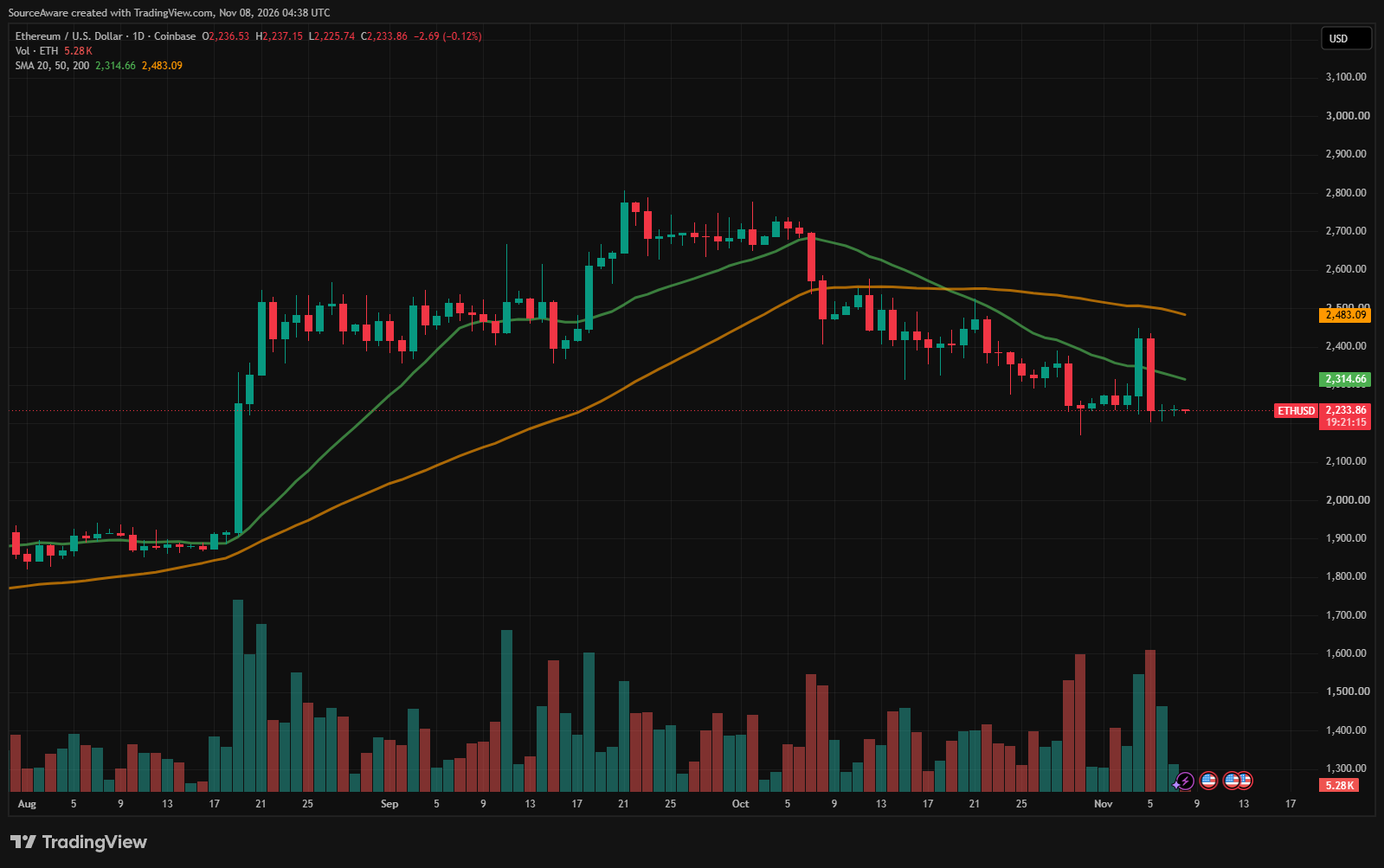
ETH/USD 1-day chart. Source: TradingView
At Saturday's close, Ethereum was near $2,237, below its 20-day simple moving average at $2,314 and its 50-day average at $2,483. Ethereum outperformed the cleaned market median, yet it still has substantial overhead resistance. A move back through the shorter average would improve the chart. Until then, ETH is a relative shelter within the selloff, not proof that large-cap demand has returned.
Uniswap Reclaims Its Short-Term Average as DeFi Peers Weaken
Meanwhile, Uniswap provided a clearer contrast. UNI/USD gained 2.15% across the completed window, from $7.06 to $7.22, after trading between $6.60 and $7.81. The pair recovered from its low while most of the screen remained negative.
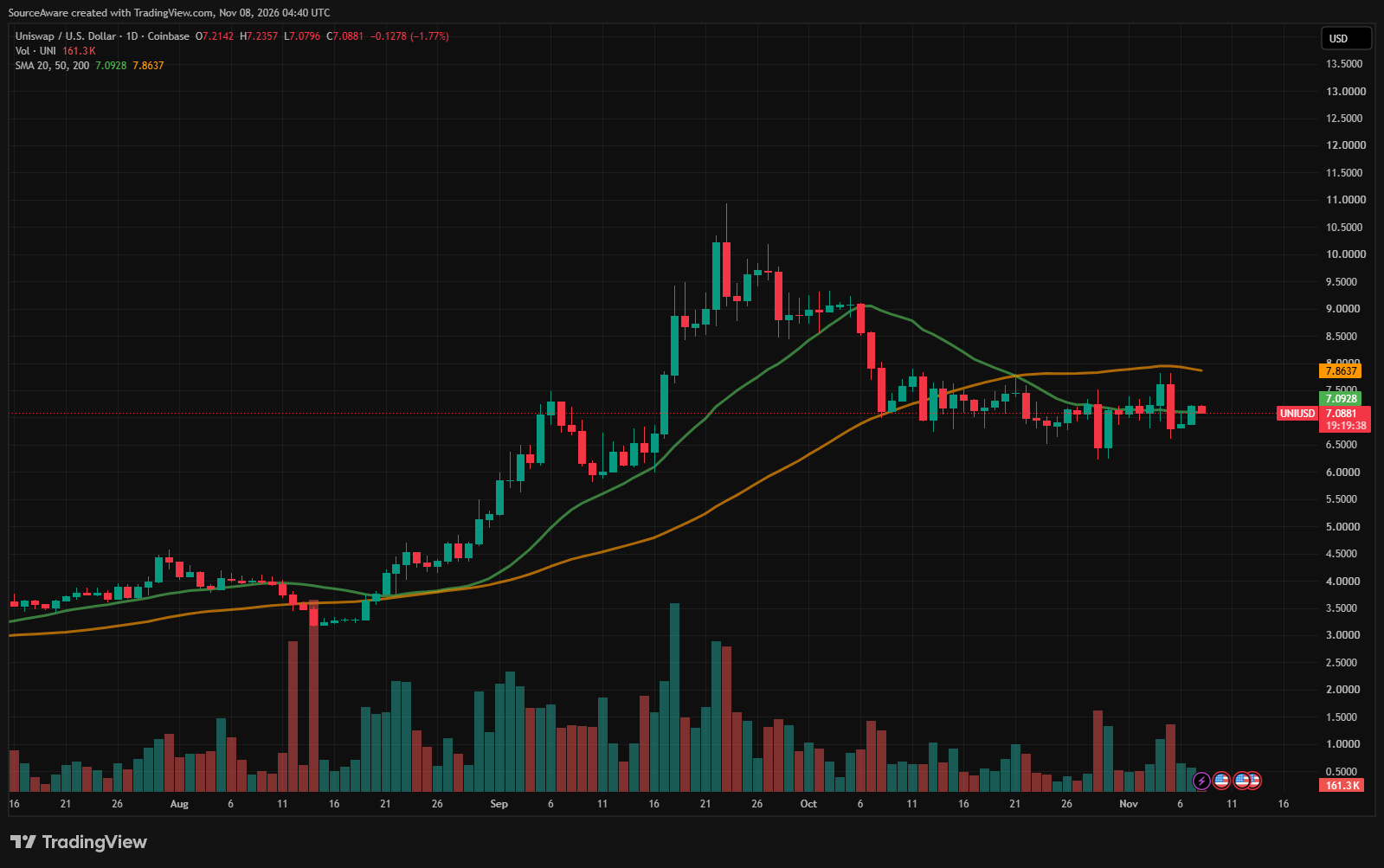
UNI/USD 1-day chart. Source: TradingView
At Saturday's close, UNI was near $7.22, above the 20-day average at $7.09 but still below the 50-day average at $7.86. That short-term reclaim shows buyers defending one liquid DeFi asset without repairing its broader technical condition. Its DeFi and oracle group had a median weekly loss of 4.00%, so the relative strength remains selective. Holding above $7.10 would make the divergence more useful. A quick rejection below that level would leave the rebound vulnerable to weak participation.
Solana Ends Near Its Weekly Low as Pressure Persists
By contrast, Solana shows the other side of the market. SOL/USD fell 5.90% across the completed window, opening at $95.29 and closing at $89.67. Its weekly range ran from $88.15 to $98.06, and the close landed near the lower portion of that range.
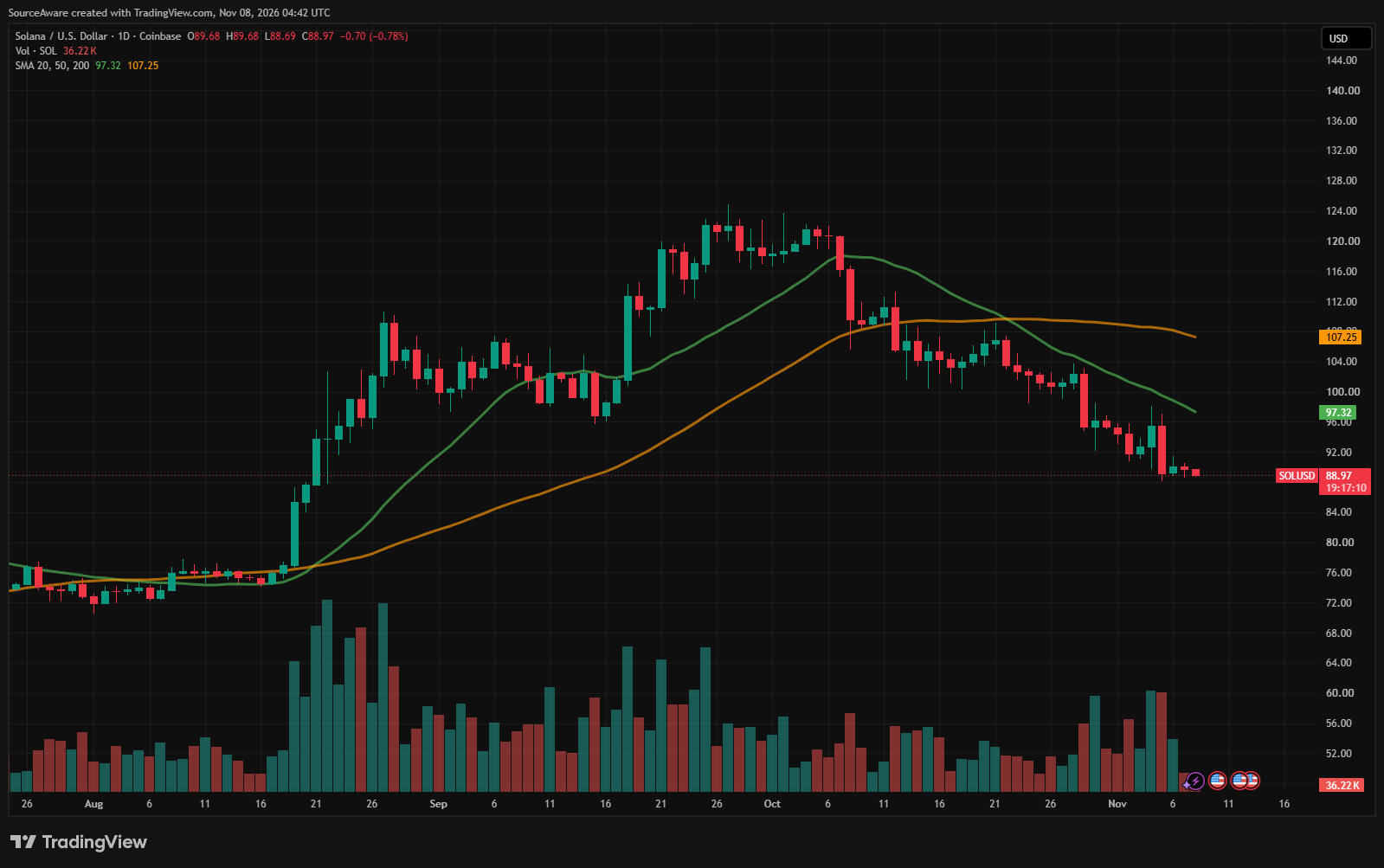
SOL/USD 1-day chart. Source: TradingView
At Saturday's close, the pair was below its 20-day average at $97.32 and its 50-day average at $107.25. Solana underperformed the cleaned market median even though it remains a large and liquid layer-one asset. A recovery above the 20-day average would show renewed demand for higher-beta exposure. Continued trading near the weekly low would suggest the market is still reducing that exposure while total capitalization appears stable.
NEAR’s Deeper Decline Leaves More Ground to Recover
NEAR was the weakest of the four selected pairs. It fell 15.71% across the completed Coinbase window, from $4.43 to $3.73, with a range between $3.61 and $4.49.
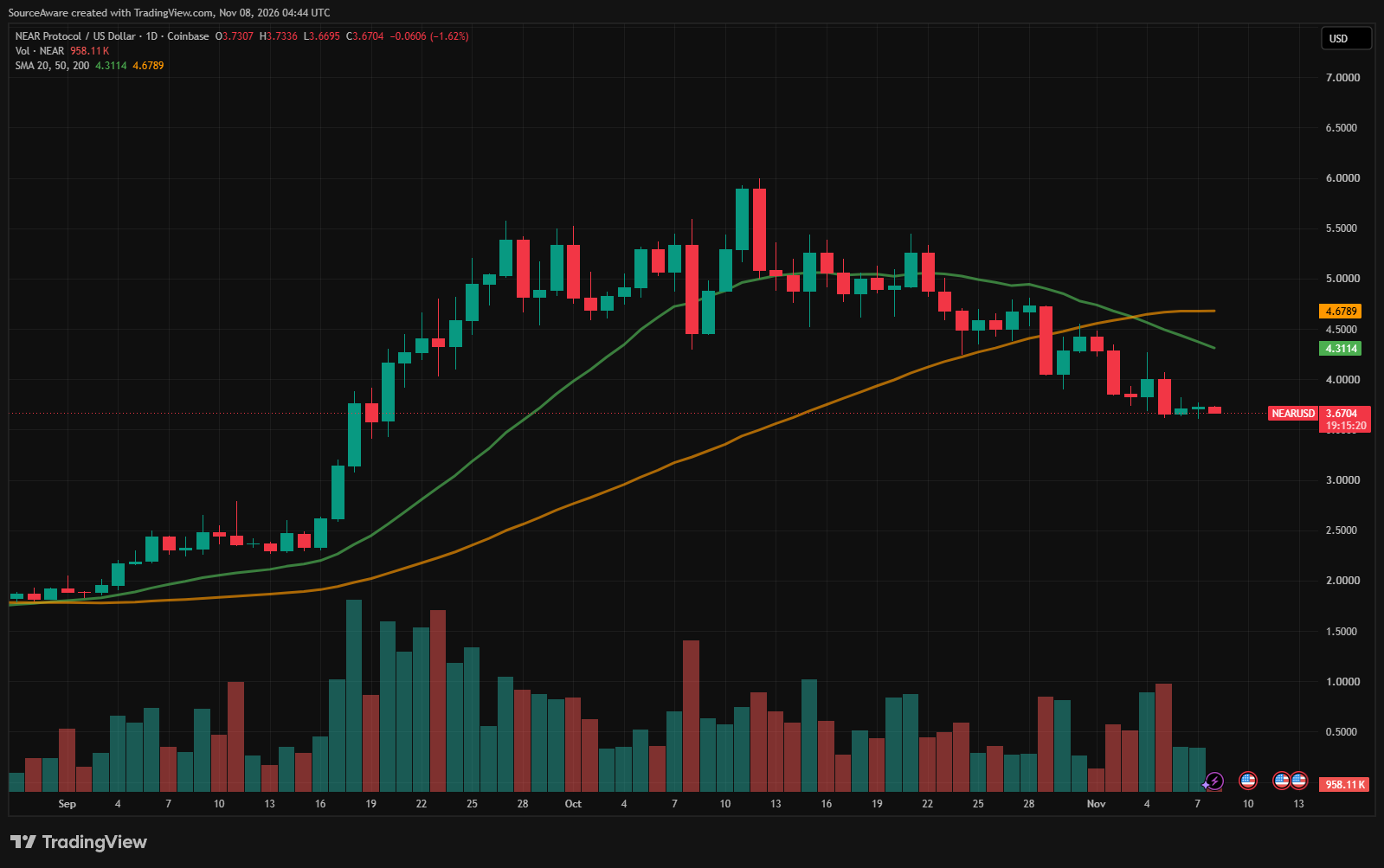
NEAR/USD 1-day chart. Source: TradingView
At Saturday's close, NEAR traded well below its 20-day average at $4.37 and its 50-day average at $4.68. The distance from those averages shows how much repair is required before the pair can challenge its downtrend. NEAR remained liquid enough to make the move relevant to the broader market. Holding above the weekly low while stronger pairs reclaim short-term averages would begin to narrow the gap. Another break below $3.61 would keep the weakest established assets in control of the risk signal.
ETF Outflows and Shrinking Stablecoin Supply Challenge the Recovery Case
U.S. spot Bitcoin ETFs recorded $1.28 billion in net outflows across the five sessions from November 2 through November 6. Spot Ethereum ETFs lost $365.2 million over the same period. Both groups briefly turned positive during the week before returning to outflows, so the direction was negative without being uninterrupted.
This flow record does not identify why the market sold off, and it does not settle whether institutions are reducing exposure or adjusting it temporarily. It shows that a major source of demand was not supporting the market during the completed part of the week. Combined with negative breadth and shrinking stablecoin supply, that makes the weekend's stability less persuasive.
The blind spot is assuming that a flat total-cap reading means sellers are finished. Large assets can keep the capitalization measure steady while weaker names continue to deteriorate underneath it. The four pair charts show that split clearly: resilience exists, but it has not spread far enough to repair participation.
What Would Strengthen the Case for a Broader Crypto Recovery
The weak-participation case would lose force if breadth moved closer to balance and the cleaned median began rising alongside the cap-weighted measure. Stablecoin supply stabilizing would add another piece of evidence, especially if ETF flows also shifted back toward sustained inflows rather than a single positive session.
Meanwhile, the pair charts offer practical confirmation points. Ethereum reclaiming its 20-day average and Uniswap holding above its own would show relative strength turning into technical progress. Solana moving back above $98.12 would indicate renewed demand for higher-beta exposure, while NEAR holding its weekly low and narrowing the gap to its shorter average would reduce the pressure from the weakest selected pair.
A different outcome remains possible. If total capitalization stays flat while breadth worsens and SOL or NEAR breaks lower, the market would be preserving the headline by concentrating strength in fewer assets.
Whether Relative Strength Can Spread Remains the Next Test
The coming sessions should show whether the market's stronger pockets can pull participation outward or remain isolated above a weak base. Ethereum and Uniswap have given buyers something to work with, while Solana and NEAR still reflect the damage beneath the headlines.
Breadth, stablecoin supply, ETF flows and the 20-day averages now provide the clearest markers. The important change would be several of them improving together, rather than another quiet day that leaves the internal split intact.
Ready to trade our overview of the crypto market? Here’s our list of the best MT4 crypto brokers worth reviewing.