


The crypto market moved sharply lower this week, yet the damage did not spread evenly. A few liquid assets rose against the pressure, leaving a market that was clearly weak without looking uniform.
Top Regulated Brokers
Bitcoin declined, most large smart-contract network tokens fell further, and then Binance, the largest crypto exchange in the world, suffered the largest hack in crypto history, adding pressure late in the week. Amid the turmoil, HYPE and Bitcoin Cash moved the other way, and their gains matter because they show that selective appetite survived, although they do not settle whether the exceptions can widen into something healthier.
That split leaves the rotation story incomplete heading into Sunday.
Crypto Breadth Was Weak Before the Binance Security Shock
By late Saturday, total crypto market capitalization stood at approximately $2.61 trillion after a small rebound. The rolling seven-day picture across the top 100 assets showed 83 in negative territory and 17 positive. That final reading confirmed the decline remained broad.
That breadth picture came with Bitcoin dominance, the share of total capitalization held by Bitcoin, near 59.9%. The combination complicates a straightforward defensive rotation thesis. Broad weekly weakness without a decisive rise in Bitcoin dominance describes dispersion rather than capital consolidating into the benchmark. Ethereum dominance sat near 10.6%.
Meanwhile, DeFiLlama's measure of USD-pegged stablecoin circulation fell from roughly $302.6 billion on October 25 to approximately $298.5 billion on November 1, a decline of about $4.1 billion, or 1.4%.
The major story of the week was the Binance hack. The exchange said unauthorized hot-wallet withdrawals via a compromised laptop caused an estimated $6.3 billion loss. The exchange reported 90% replenishment by Saturday morning, while withdrawals remained suspended pending a planned Sunday reopening. That left participation constrained by a live security event.
Four Assets Show How Uneven the Week Became
Large Layer-1 tokens remained the weakest established group, with a median seven-day decline near 5.7% and Cardano, Solana and TRON among the harder-hit names. The payments and value-transfer group declined about 2.0% at the median, while privacy assets remained slightly positive as Zcash offset Monero's decline. The DeFi-oracle basket finished close to flat at the median, but that result concealed sharp intraperiod stress around the Binance breach.
This four-pair set spans that dispersion without turning the article into a token roll call. Bitcoin supplies the market benchmark. HYPE shows the strongest liquid upside exception, Bitcoin Cash shows a smaller gain in an established payments asset, and AAVE captures the sharp security-driven stress and partial rebound inside DeFi. Their gaps are more informative than any one pair in isolation while top 100 breadth remains negative.
Bitcoin Falls Below Its Short- and Medium-Term Trend Measures
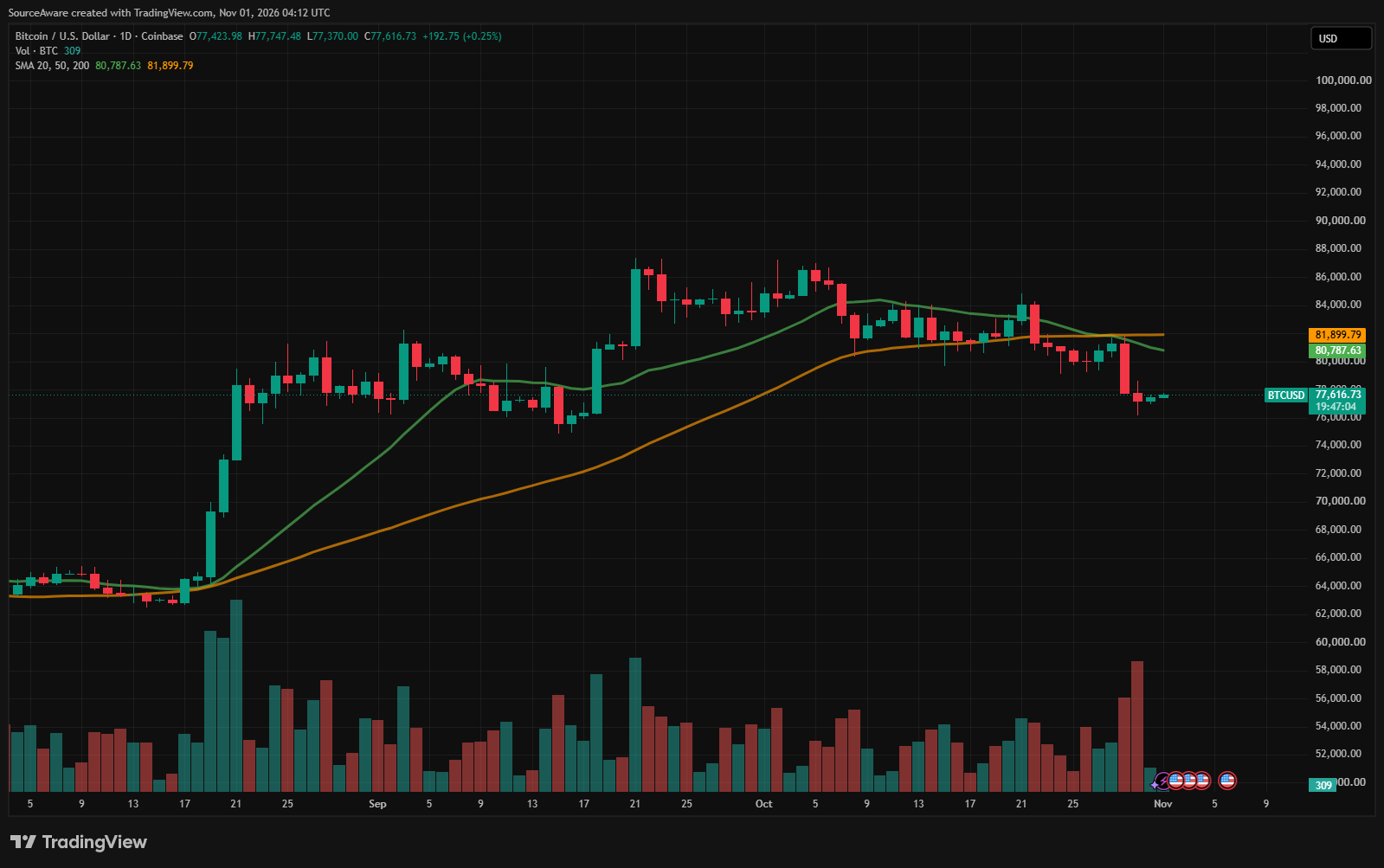
Bitcoin closed Saturday near $77,424 on Coinbase, leaving the completed seven-candle window down approximately 4.14%. CoinMarketCap's post-close rolling seven-day figure stood at -3.97%. The Coinbase window opened near $80,770 and traded between $76,141 and $81,890.
BTC/USD 1-day chart. Source: TradingView
Both the completed 20-day and 50-day simple moving averages, at $80,787 and $81,899 respectively, remained above the close. The week's weakness predated the Binance breach, which accelerated the late-week break and left Bitcoin below two widely followed measures of its recent trend.
HYPE Separates From the Market With a Strong Weekly Gain
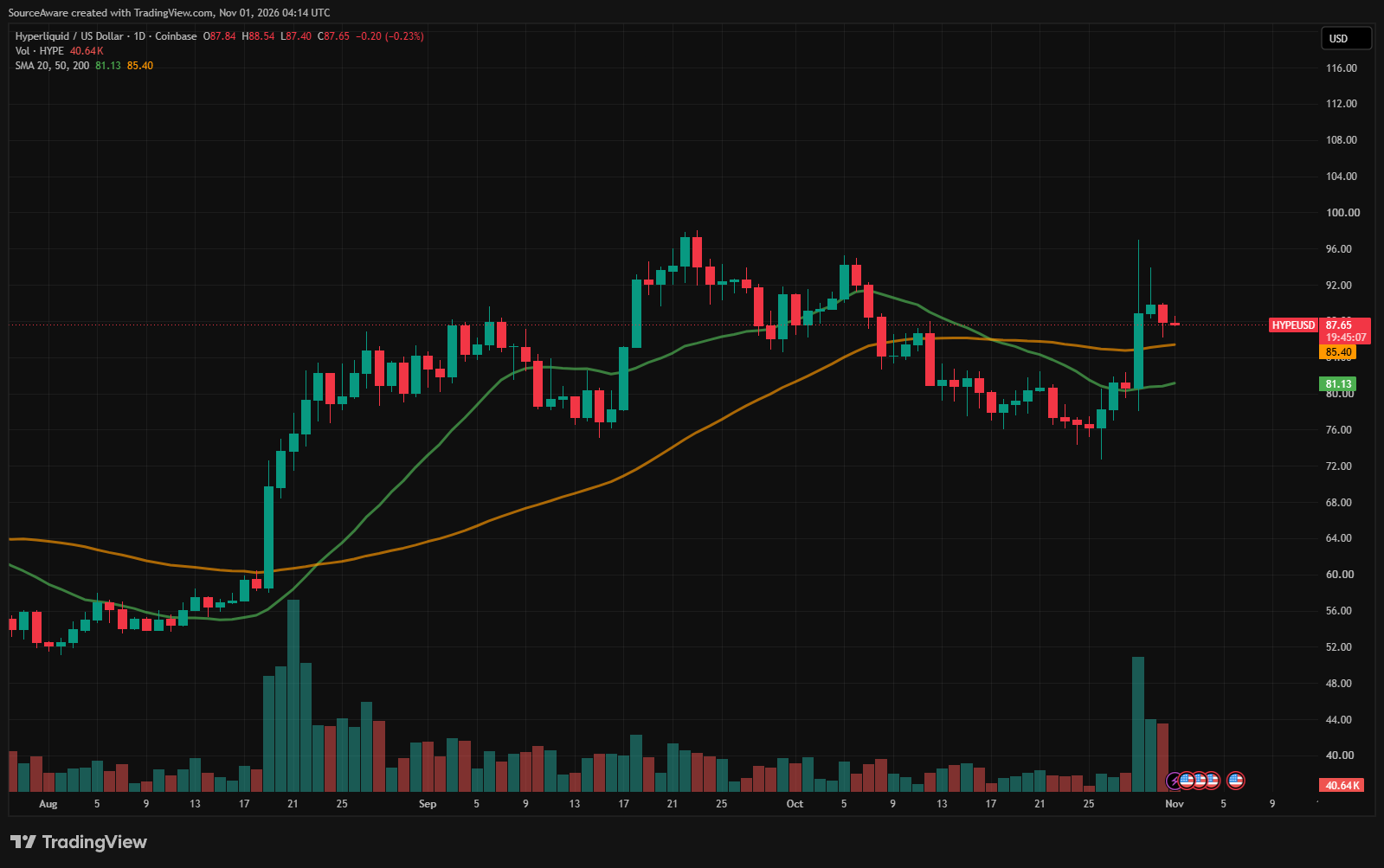
By contrast, HYPE was the clearest positive outlier in the selected set. It closed Saturday near $87.84 on Coinbase, leaving the completed seven-candle window up approximately 14.69%; CoinMarketCap's post-close rolling seven-day figure was +15.11%. The Coinbase window opened near $76.59 and traded between $72.73 and $96.99.
HYPE/USD 1-day chart. Source: TradingView
The completed 20-day SMA at $81.13 and the 50-day SMA at $85.40 sat below the close. ICE's October 29 agreement with Trade to pursue U.S.-regulated perpetual markets built on Hyperliquid provides a concrete catalyst, although the plan remains subject to regulatory approval. HYPE has since pulled back from its weekly high, so the announcement supports the divergence without guaranteeing it will persist.
Bitcoin Cash Holds a Smaller but Notable Positive Divergence
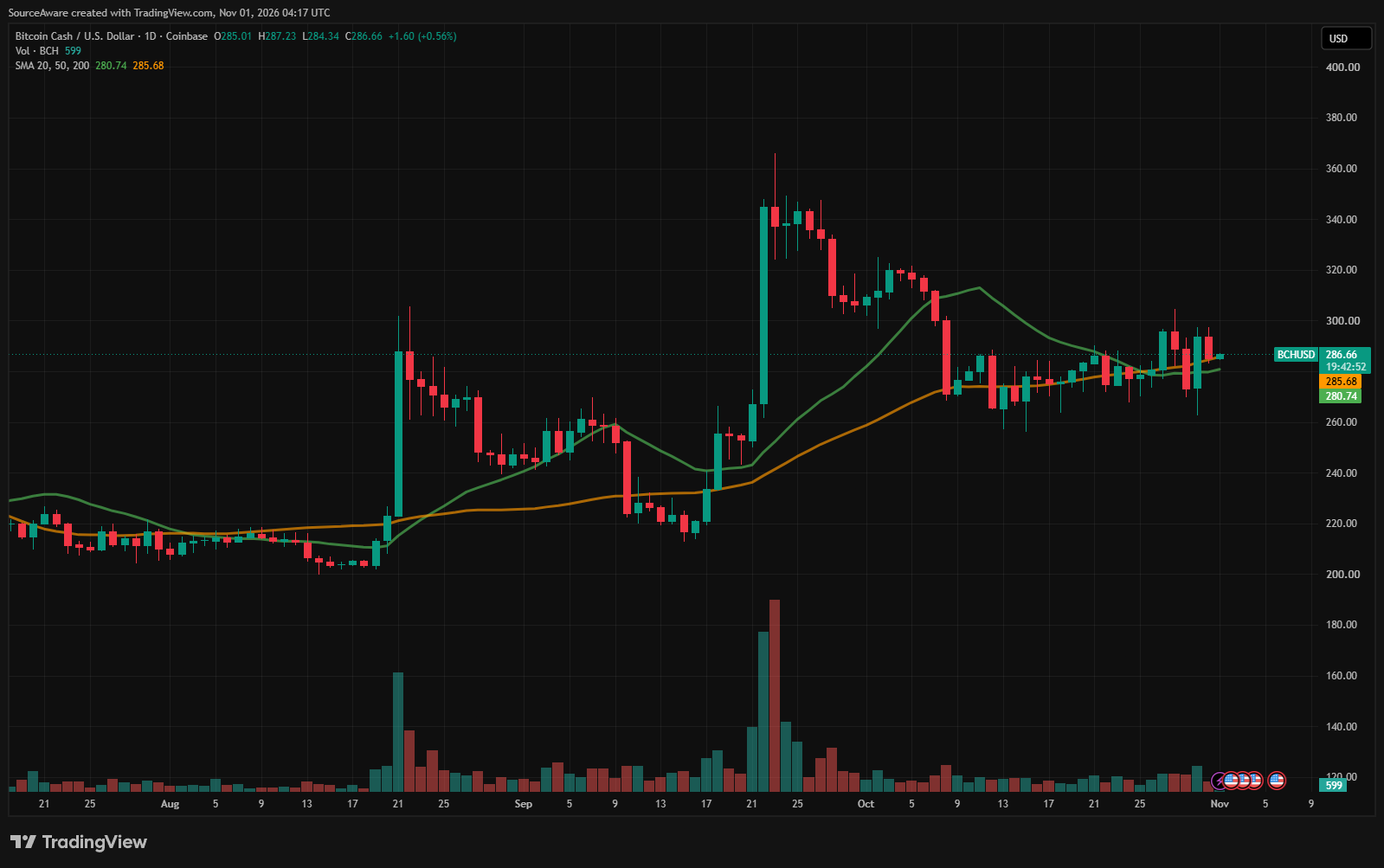
Meanwhile, Bitcoin Cash posted the second positive exception. It closed Saturday near $285 on Coinbase, leaving the completed seven-candle window up approximately 2.82%; CoinMarketCap's post-close rolling seven-day reading was +2.96%. The Coinbase window opened near $277 and traded between $263 and $304.
BCH/USD 1-day chart. Source: TradingView
The completed 20-day average at $280 and 50-day average at $285 both sat below the close. No verified BCH-specific catalyst explains the move, so its relative strength should be treated as observed price behavior rather than a narrative claim.
AAVE’s Rebound Follows a Sharp Security-Linked Selloff
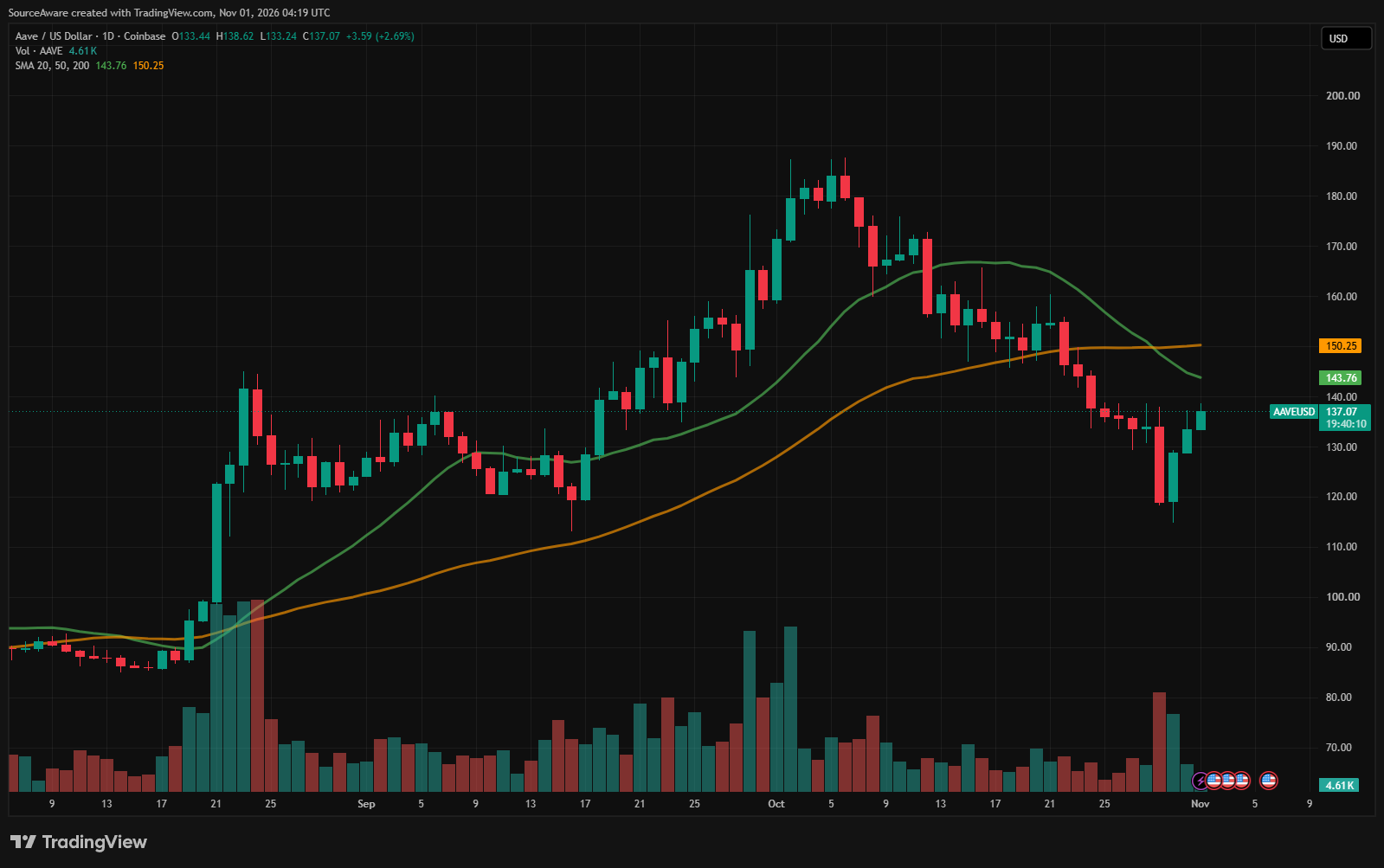
The catch was AAVE, which absorbed the sharpest intraperiod loss among the selected assets before rebounding. It closed Saturday near $133 on Coinbase, leaving the completed seven-candle window down approximately 2.99%; CoinMarketCap's post-close rolling seven-day figure was -0.50%. The Coinbase window opened near $138 and traded between $115 and $139.
AAVE/USD 1-day chart. Source: TradingView
Both the completed 20-day SMA at $143 and the 50-day SMA at $150 remained above the close. Aave's risk team said the Binance exploiter supplied 60 million USDT and borrowed about $44.6 million of wrapped ether before the protocol froze markets across multiple networks. Markets were later reopened with tighter collateral and borrowing settings. That sequence gives AAVE's selloff and rebound a verified security catalyst while leaving the token below its tracked trend measures.
ETF Outflows and Stablecoin Contraction Add to Pressure
U.S. spot Bitcoin ETFs recorded $643.2 million of net outflows on October 30, according to Farside, reversing the $440.8 million of net inflows accumulated across the first four sessions. The full trading week therefore ended with approximately $202.4 million of net outflows. Friday's reversal was larger than any earlier daily inflow and arrived as the Binance breach and broader risk-asset weakness pressured Bitcoin.
That early ETF demand did not prevent the broad market decline, and Friday's outflow removed the week's remaining institutional-flow cushion. Stablecoin circulation also declined during the period. The measures cover different parts of the market, but together they leave participation weaker than the two positive pair exceptions suggest. Binance's continuing withdrawal suspension adds a separate operational constraint. Its planned Sunday reopening, if completed without further disruption, could reduce that pressure; a delay or another incident update would keep security risk at the center of the market story.
What Could Turn Isolated Strength Into a Broader Recovery
The current read is a broad decline with selective survivors. It rests mainly on negative breadth, Bitcoin trading below both tracked averages, and the distance between HYPE or BCH and the weaker large Layer-1 group.
So, if Bitcoin recovers its 20-day moving average near $80,994 while breadth stabilizes, the week's move would look more like a sharp range test than a durable loss of support. Continued gains in HYPE or BCH would carry more weight if more established assets joined them. A smooth reopening of Binance withdrawals and renewed ETF inflows would also weaken the case that participation remains impaired. The evidence would need to broaden beyond two winners before the market could support a rotation reading.
Sunday Opens With Crypto Participation Still Unresolved
Saturday's close confirmed Bitcoin below both tracked averages and left only 17 of the top 100 assets positive over seven days. HYPE and Bitcoin Cash now offer the first test of whether isolated strength can attract company as the new week begins. The unresolved part is participation: a few winners can survive a weak market for a long time, but a rotation needs enough followers to become visible beyond the exceptions.