


AUD/USD: Hot Australian Inflation Could Trigger Bullish Continuation Toward 0.7065
Top Regulated Brokers
Australian quarterly trimmed mean CPI data and Fed rate expectations could drive AUD/USD price action this week. Discover important support and resistance levels worth watching.
This pair remained in consolidation mode in early trade on Tuesday as market participants brace for key domestic inflation data and the Federal Reserve’s October interest rate decision later this week, two key catalysts that could drive the Aussie dollar’s next move. Price action in the pair may see near-term volatility as traders reposition ahead of this week’s busy calendar.
Why Risk Appetite Is Supporting AUDUSD
While Wednesday’s Fed interest rate decision will take center stage this week, market participants who trade the Aussie dollar will also closely eye domestic inflation numbers released earlier the same day. Particularly, traders will scrutinize the quarterly trimmed mean print, a figure that helps determine if inflationary pressures are broadening beyond higher energy prices. A hotter-than-expected reading could strengthen the pair by bringing forward expectations that the Reserve Bank of Australia (RBA) could hike rates when it meets next week to deliver its November rate decision.
However, any bullish short-term sentiment could run into pressure when the Federal Reserve’s rate decision lands later on Wednesday. Although market participants expect the central bank to leave its benchmark funding range unchanged this month after a 25 basis point hike in September, hawkish remarks from Chair Kevin Warsh during the accompanying press conference could boost bets of a December rate hike, potentially strengthening the Greenback and placing downward pressure on the Australian dollar.
AUDUSD’s Recovery Is Testing Market Conviction
After confirming a double bottom on the chart by closing above the pattern’s neckline, the pair has traded sideways since mid last week, indicating that market participants are potentially accumulating long positions before a continuation move higher. It’s also worth pointing out that retracements have been short lived since the 50 moving average (MA) crossed above the 200 MA last week to form a bullish golden cross, also pointing to improving momentum.
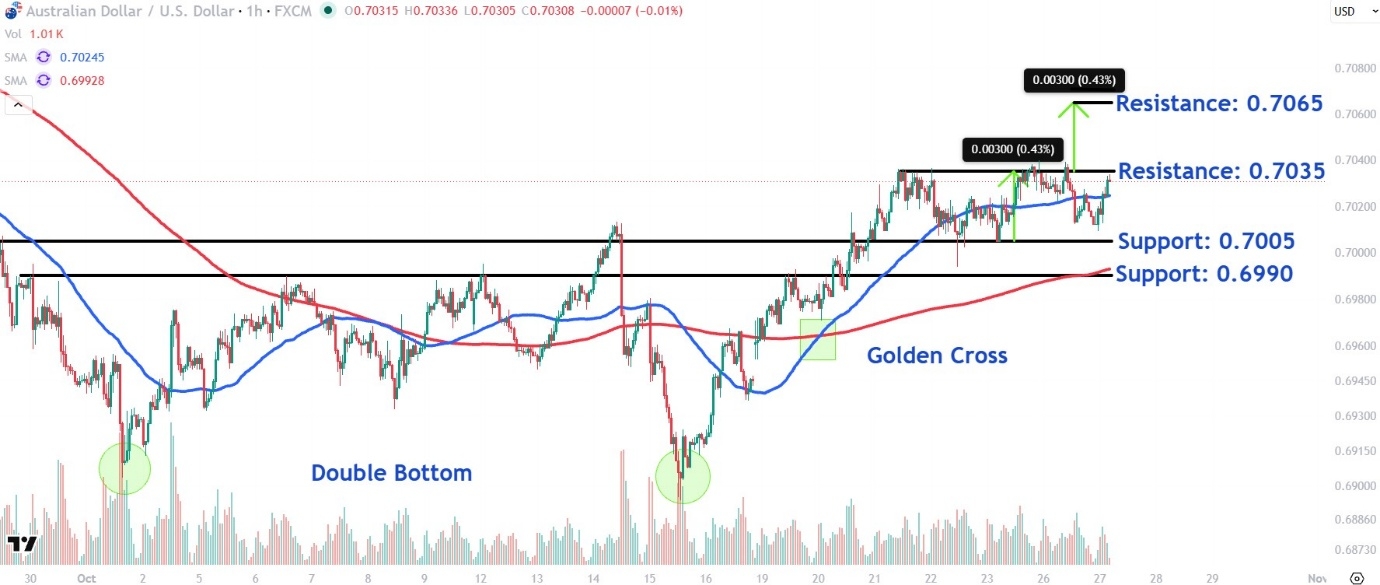
AUD/USD Price Chart – Support and Resistance Levels
Where AUD/USD Buyers Could Regain Control
The first support level to monitor closely sits around 0.7005. This area on the chart would likely attract buying interest near a horizontal line the marks the bottom of the current trading range and stretches back to a late September countertrend high.
Bulls’ failure to successfully defend this important level could see the pair revisit lower support near 0.6990. Traders may look to open long positions in this location near the rising 200 MA and an established trendline, which could flip from prior resistance into future support.
The Resistance Zone That Could Challenge AUD/USD
Buying from current levels could see a swift retest of the trading range’s top trendline around 0.7035. Tactical traders who have accumulated long positions during the recent consolidation may seek exit points near several peaks that have formed on the chart over the past week.
To project a potential upside target above these recent peaks, traders can use the measured move technique. When applying this analysis, we calculate the distance of the current trading range in pips and add that amount to the range’s top trendline. For example, we add 30 pips to 0.7035, which forecasts a target of 0.7065.
What Could Sustain AUDUSD’s Cautious Recovery
Given the recent double bottom formation on the AUD/USD chart, hotter-than-expected domestic inflation data this week could act as a catalyst for the pair’s next move higher. However, Wednesday’s Fed rate decision could limit any meaningful upside if Chair Kevin Warsh during his press conference hints that the central bank needs to take further action to contain inflation.
Sources:
https://au.finance.yahoo.com/news/rare-chance-see-bank-react-010000407.html
https://www.cmegroup.com/markets/interest-rates/cme-fedwatch-tool.html