


Fundamental Backdrop and Market Sentiment
I wrote on 6th September that the best trades for the week would be:
Long of Sugar following a new 1-year high daily closing price. This did not set up.
Long of Soybeans. Soybean futures have declined by 0.91%.
Long of Ethereum following a daily close above $2,515. This only set up at Friday’s close and the price is unchanged.
Long of the following Yen crosses:
The total loss of 4.89% averages 0.82% per asset.
A summary of last week’s most important data in the market:
US Federal Reserve Policy Meeting: a “hawkish hike”
Bank of Japan Policy Meeting: a “dovish hike”
Bank of England Policy Meeting: a neutral hold.
The dominant theme last week was that the world’s three most important central banks were all leaning more hawkish, although to different degrees. The Federal Reserve delivered the most immediately market-moving decision, raising its federal funds target by 25 basis points to 3.75%–4.00%, its first increase since 2023, in a unanimous vote. The accompanying projections kept another increase this year in play, confirming that inflation and the energy-price shock remain the Fed’s chief concerns. The US Dollar initially strengthened as yields rose, while US equities fell sharply after the announcement—the Dow Jones Industrial Average lost more than 600 points on the day—as traders repriced the prospect of higher borrowing costs for longer.
The Bank of England kept its Bank Rate unchanged at 3.75%, but it was not a genuinely dovish hold. The 6–3 vote saw three Monetary Policy Committee members favour an immediate 25-basis-point hike, while the Bank warned that inflation could rise above 4% in early 2027 if energy-driven pressures persist. Its decision to pause active gilt sales for six months complicated the message somewhat, but currency traders focused on the absence of an actual rate increase and the softer-than-feared immediate policy stance: sterling weakened and UK rate expectations declined after the decision. For stock markets, the pause in rates and slower balance-sheet reduction offered some short-term relief, although the implication of renewed inflation risk limits the scope for a sustained risk-on rally in UK assets. UK inflation was more clearly uncomfortable for policymakers, even though it did not cause an immediate major move in Sterling. Annual CPI accelerated from 2.9% to a five-month high of 3.1% in August, largely due to sharply higher motor-fuel prices and airfares. Yet core inflation held at 2.6% for a fourth consecutive month, and services inflation was unchanged at 3.4%, giving the Bank of England some reassurance that inflationary pressure had not yet broadened significantly. GBP/USD and EUR/GBP were little changed following the release, as the data broadly validated expectations that the BoE would keep rates unchanged, while strengthening the case that its next move is more likely to be a hike than a cut.
Finally, the Bank of Japan raised its policy rate by 25 basis points to 1.25%, its highest level in 31 years, by a 7–2 vote. Governor Kazuo Ueda made clear that the Bank is now concerned with preventing inflation from overshooting its 2% objective, signalling that further tightening remains possible if price and wage conditions justify it. However, because the move had been widely expected, the immediate reaction in the Yen was more restrained than it might otherwise have been; the broader lesson for Forex traders is that the era of ultra-cheap Japanese money is continuing to fade, which is potentially bearish for USD/JPY and other yen carry trades over the medium term. Japanese equities faced the usual tension between higher domestic rates—which can pressure valuations—and the prospect of a stronger Yen, while global equity markets remained chiefly driven by the Fed’s more direct threat of higher US financing costs.
Outside the central-bank decisions, the other major market story was the renewed oil-supply shock caused by escalation in the Middle East. Fresh attacks on Saudi energy infrastructure, the shutdown of the East–West pipeline, and increased threats to shipping through regional waterways drove Brent crude above $100 per barrel, briefly toward $110, while WTI crude traded above $100. The move revived global inflation concerns just as major central banks were becoming more hawkish, supporting the US Dollar on safe-haven demand and higher-rate expectations while pressuring global equities and bonds. Energy stocks were a relative beneficiary, but the wider risk mood deteriorated as investors considered the possibility that high fuel costs could prove persistent rather than a short-lived geopolitical spike.
Canada’s inflation data reinforced the view that the Bank of Canada can remain patient. Headline CPI held steady at 3.0% year-on-year in August, but the more policy-relevant underlying measures were subdued: CPI-trim was 1.9%, CPI-median 2.0%, and inflation excluding food and energy was 2.1%. The main upward contribution continued to come from energy—gasoline prices were more than 20% above a year earlier—rather than broad domestic price pressure. The Canadian Dollar softened modestly after the release, as the figures did not provide a compelling reason for the Bank of Canada to bring forward another rate increase.
New Zealand’s second-quarter GDP result was modestly encouraging. The economy expanded by 0.2% quarter-on-quarter, above both the 0.1% consensus forecast and the Reserve Bank of New Zealand’s expectation of no growth; annual growth reached 2.6%, also beating the 2.2% forecast. Growth nevertheless slowed markedly from the 0.8% recorded in the first quarter, indicating that the economy is recovering but remains vulnerable to weaker confidence and the effects of the Middle East crisis. The data reduced concern over an imminent growth downturn and provided some support to the New Zealand Dollar, while making it less likely that the RBNZ will need to turn dovish in the near term.
The Week Ahead: Key Data and Events to Watch
Next week will see very little in the way of highly important data items. The coming week’s most important data points, in order of likely importance, are:
Swiss National Bank Policy Meeting
Australia Unemployment Rate
Monday to Wednesday are public holidays in Japan while Friday is a public holiday in China.
Monthly Forex Forecast: September 2026 Overview
For the month of September, I made no forecast, as the US Dollar had no real long-term trend. It is starting to look as if there may be an emerging long-term bullish trend.
Weekly Forecast 20th September 2026
There were no excessive moves in currency crosses last week, so I make no forecast.
Volatility was unchanged last week, with 26% of the notable currency pairs and crosses moving by more than 1% in value. Next week’s volatility is likely to be lower.
You can trade these forecasts in a real or demo Forex brokerage account.
Technical Overview and Key Levels
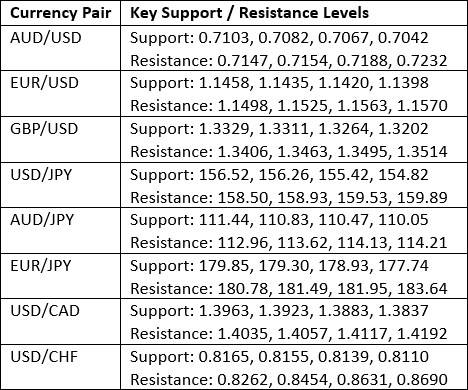
Key Support and Resistance on Major FX Pairs
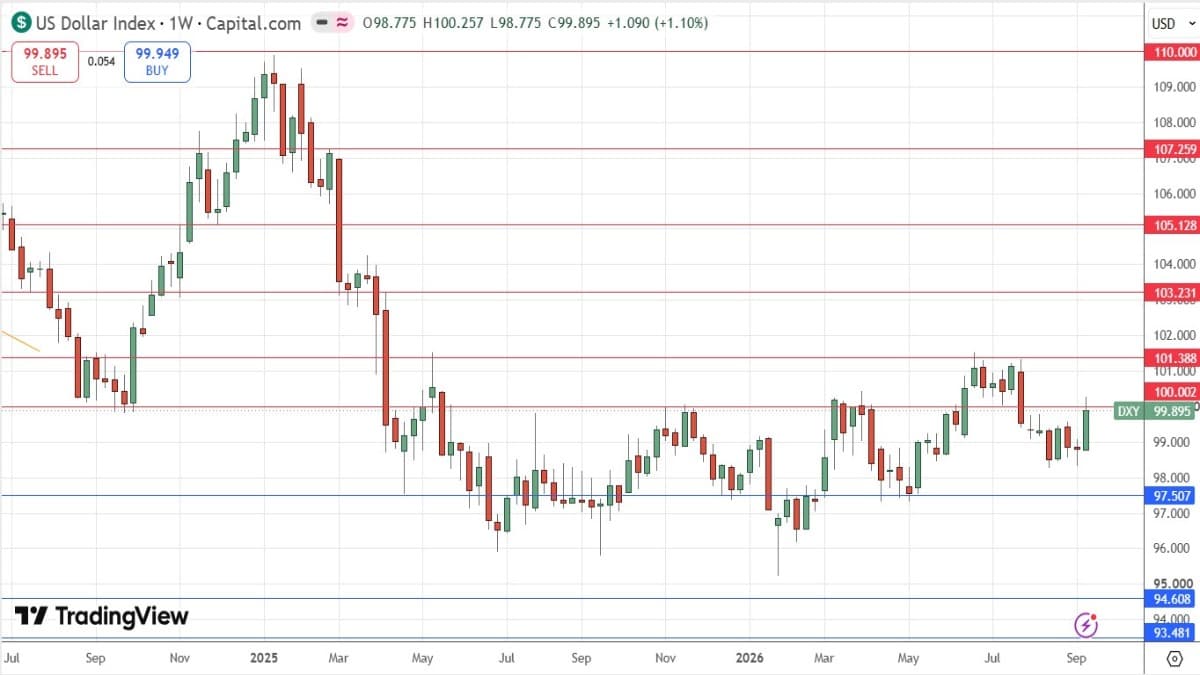
US Dollar Index
The US Dollar printed a relatively large and full bullish candlestick last week, but it did reject the resistance level confluent with the huge round number at 100. While many analysts are now seeing the greenback in more bullish terms, technically, it is showing only a mixed long-term trend, with the price below its level of three months ago but above where it was six months ago. So, there are a couple of major bearish technical factors in the mix despite last week’s strong rise.
The more bullish atmosphere is due to the Fed’s more hawkish rhetoric on inflation, with markets seemingly convinced now that the Fed will do what it takes to get inflation down to its 2% target by 2029. Markets also seem to believe this will take just one more rate hike by the end of 2027.
I think there are good reasons to take a bullish bias here, or at least to not particularly want to be short of the US Dollar, unless there is something very attractive which happens to be priced in USD. Yet technically, we are not there yet – we need to see a weekly close above 100.00. If we get a weekly close at a fresh 6-month high price, which is not far away, long USD will become extremely attractive.
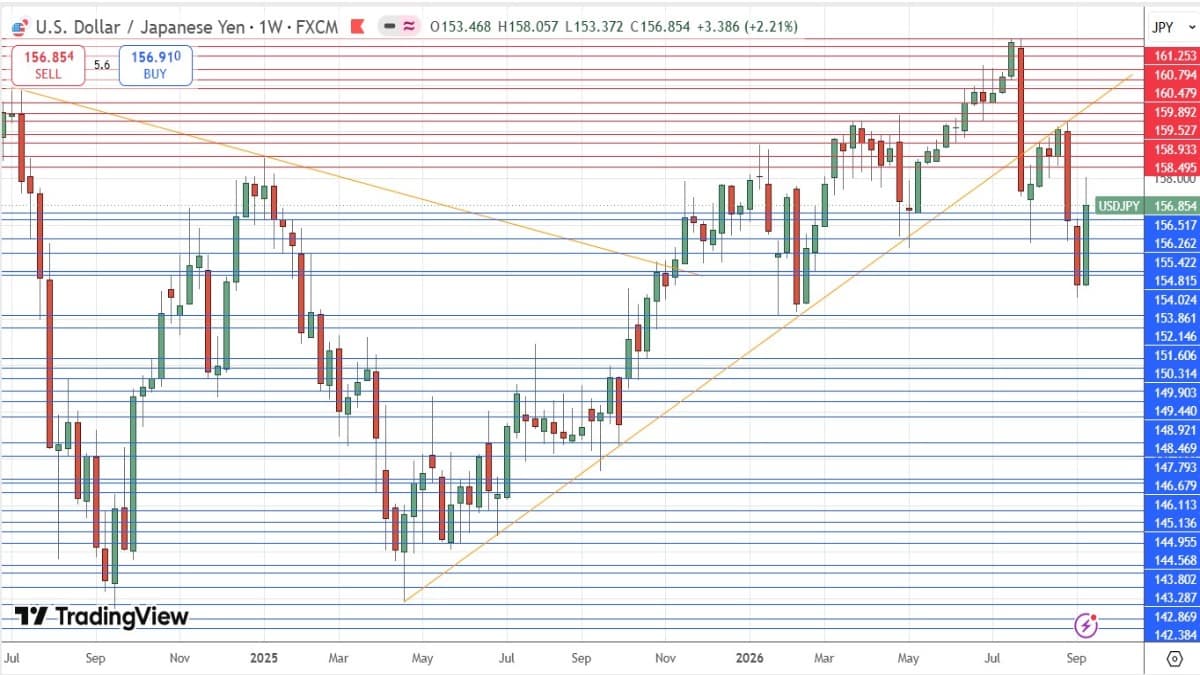
USD/JPY
There was a strong bullish move in the USD/JPY currency pair last week. Both central banks involved in this currency pair gave this rise a tailwind. The Fed made a hawkish hike and pushed the greenback higher. The Bank of Japan hiked its interest rate as expected, but markets noted the two dissenting votes, and the fact that Governor Ueda failed to give a timetable for future rate hikes, instead falling back on the old as needed formula. This caused Yen longs to hurry to take profits, sending the Yen tumbling at the end of the week, and putting this currency pair at the centre of the Forex market.
Technically, it is worth noting that although there was a strong reversal, it has not invalidated any technical chart pattern – bulls will have to get the price established above 158.50 to achieve that. It could well be that we start to see the Yen make gains again over the coming week, but it might struggle to achieve that against a strong USD – might be better being long of the Yen against other currencies.
I think this currency pair is going to be a bit unpredictable, but it should continue to show plenty of volatility making it attractive to day traders. The Yen generally is the most volatile currency in the Forex market and the one active traders should probably be watching most closely, along with the US Dollar.
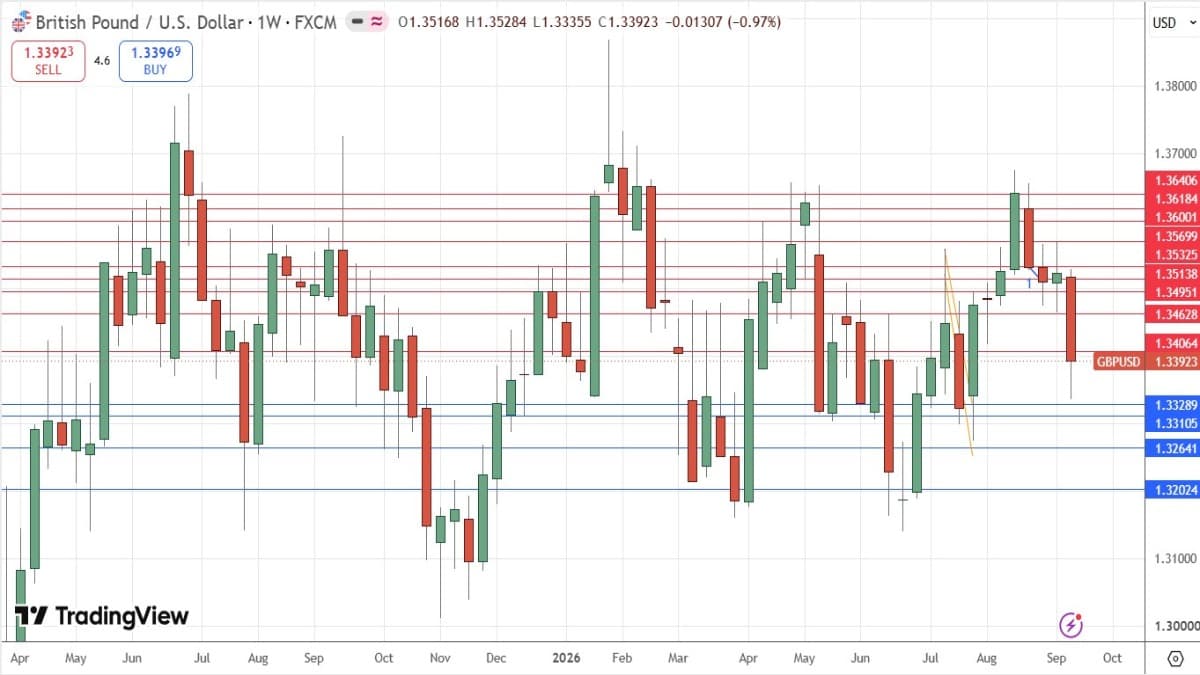
GBP/USD
The GBP/USD currency pair has spent more than a year in what is truly a consolidation pattern between about 1.3100 and 1.3650. The price was moving down from the high of this range but would not break down below 1.3500, which was offering some stubborn support. However, the hawkish Federal Reserve and neutral Bank of England policy meetings last week finally triggered a more significant breakdown.
I think this situation could persist into the coming week, with the resistance confluent with the round number overhead at 1.3400 could be a good short trade entry point if it is tested and rejected. The price could then easily fall to the next support level at 1.3329, which is very close to last week’s low price.
NZD/USD
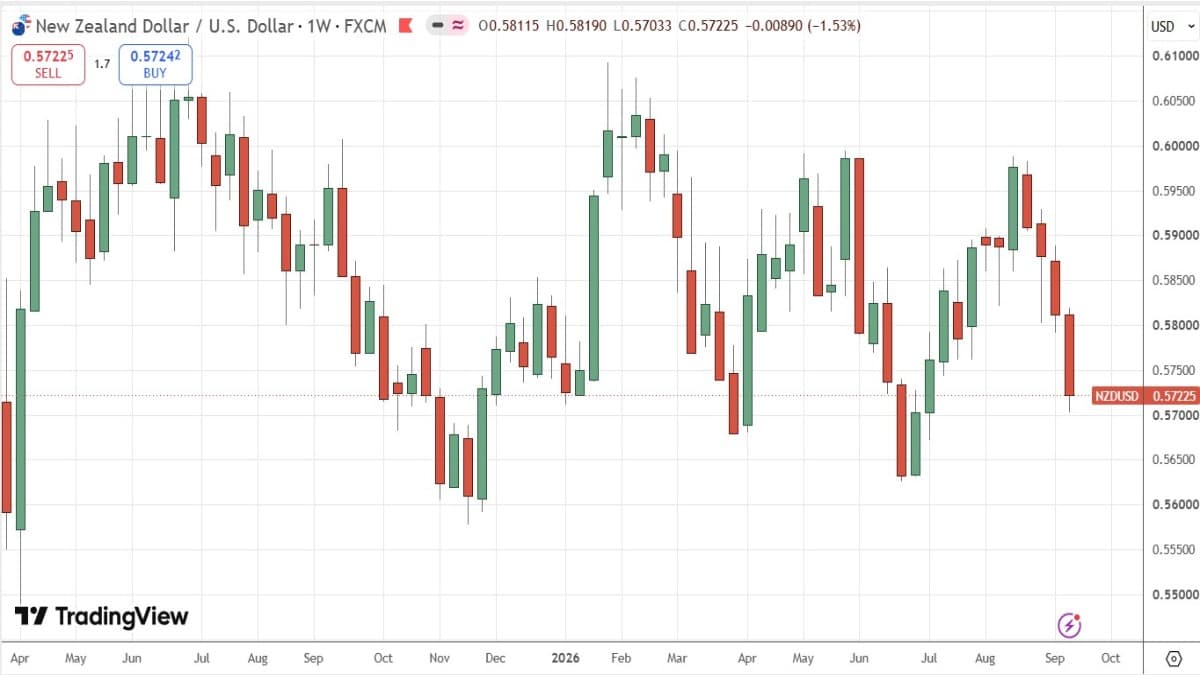
The New Zealand Dollar was again one of the weakest major currencies last week, as markets see New Zealand as a slowing economy highly exposed to energy imports, which points towards a further slowdown and suggests that the RBNZ is not going to be able to hike rates if it can possibly avoid doing so. This weakness has become quite persistent, making the Kiwi a good choice as a short counterparty currency for a Forex trade.
I have already talked about why the US is strong, although there are some technical resistances which remain intact and that might mute the bullish outlook there a bit.
The NZD/USD currency pair looks prone to further strong falls, and could be a good choice for Forex day traders looking for the right instrument to get involved in. The weekly price chart below shows that we have now seen four consecutive weeks of strong downwards price movement. I think the momentum is quite likely to continue, with key support only really becoming a factor if the price gets close to the 0.5600 handle.
Soybean Futures
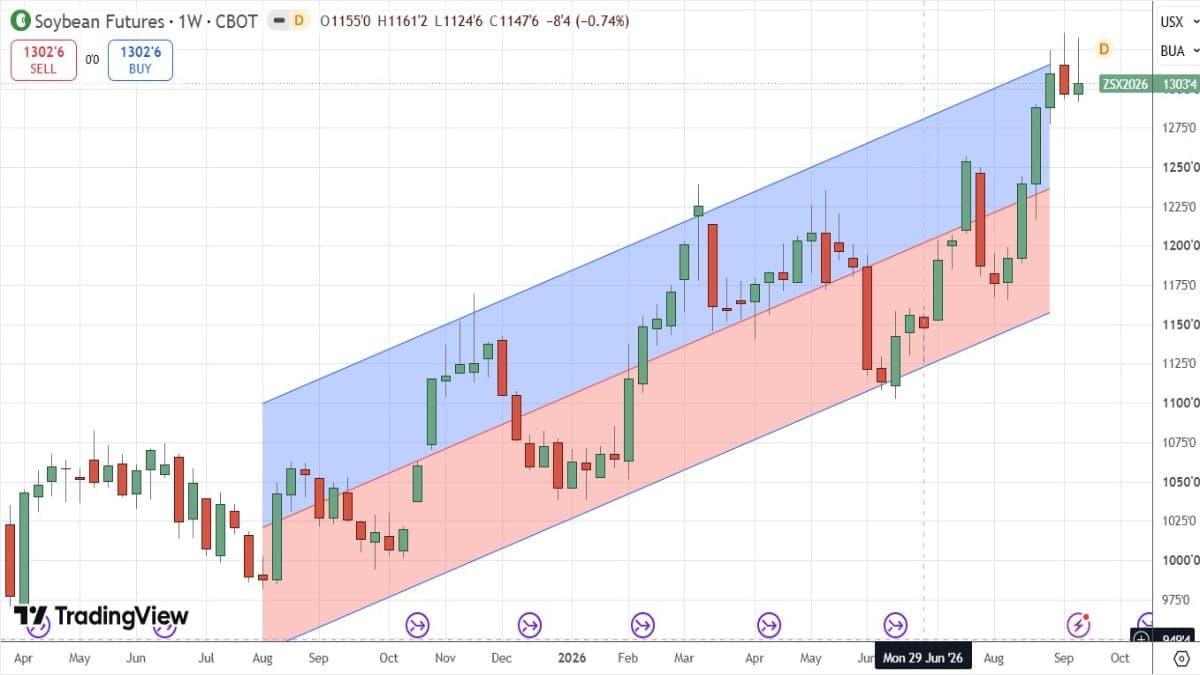
Soybean Futures got close to making another new 2.5-year high price last week but fell slightly short of doing so. The weekly candlestick gave up most of its earlier gains by the end of the week but it was still an up week.
Other commodities, especially softs, have also lost bullish momentum. Trend traders will mostly still be long here, but there are some signs that this trend is running out of steam, so it pays in trend trading to use a trailing stop loss.
There are signs that this trend could be unusually reliable, as for several months the price action has been almost completely held by ascending price channel drawn via the linear regression anlaysis study visible in the price chart below. The latest breakout sent the price above the top of the channel, which was a bullish sign.
If you have not entered this trade yet then it is worth considering, because being long of commodities at long-term bullish breakouts has historically been a very profitable trading strategy. It might be wise to control risk by entering with half the normal position size, as the move might be very over-extended.
The price of Soybeans has been rising in recent months as markets have started to price in Black Sea disruption due to the Russia/Ukraine war but even more importantly, stronger Chinese buying plus late-season crop risk.
If Soybean futures are too big for you, consider an alternative ETF like SOYB which is much more affordable. This ETF has also lately been performing better than the futures contracts.
WTI Crude Oil
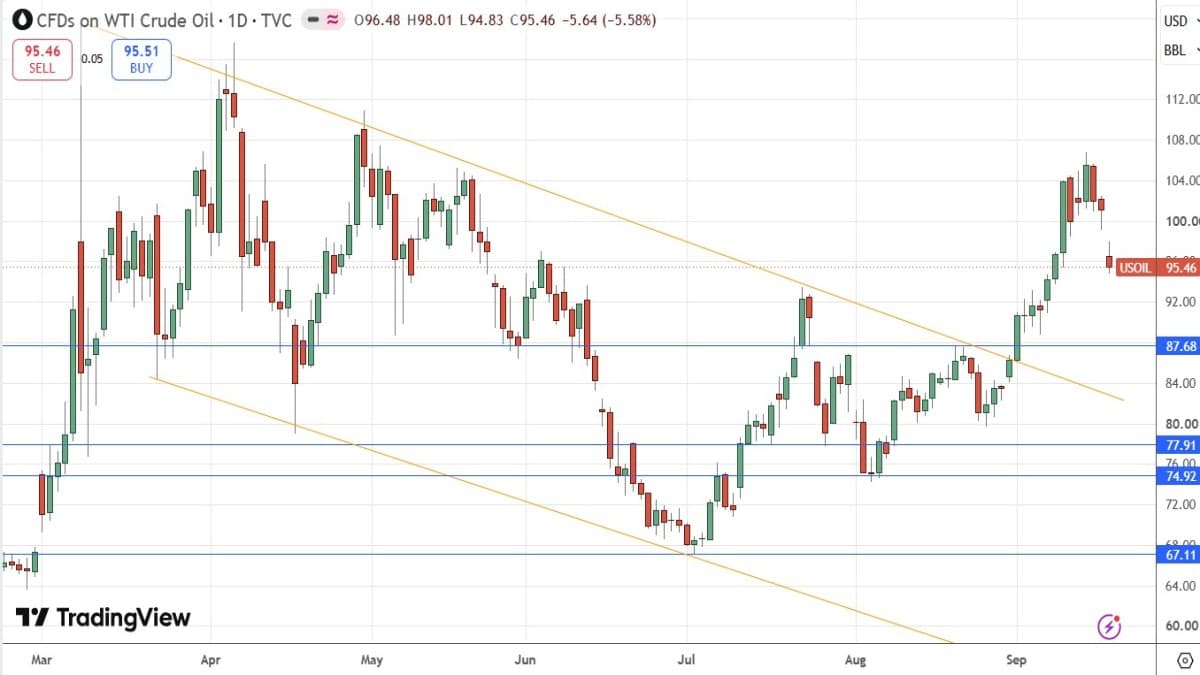
WTI Crude Oil continued to advance during the first part of last week, making a new four month high price following its channel breakout, before falling quite sharply at the end of the week with an overnight gap lower, making a down week in the end.
The change from bullish to bearish has been caused by a quiet willingness on the part of some Iranian politicians to put a deal with the USA back on the table. This time, President Trump has enough sense not to present himself as desperate for a deal. I still doubt it will happen, but President Trump will be extremely happy if he can just keep Iran out of the headlines and prevent any US casualties until after the midterm elections, which will be held on Tuesday 3rd November.
Iran’s allies the Houthis have been busy successfully attacking Saudi Arabia and threatening the Bab El Mandeb strait. However, there is also evidence that the Houthis have been talking to the USA this week.
Some analysts see a possible Iranian attack over the coming weeks as likely to happen. It just goes to show you that uncertainty persists and news headlines are capable of driving the price of crude oil both higher and lower depending upon the headline. This makes crude oil dangerous to trade and for most traders, it is likely best left alone.
Day traders might find this an interesting asset if they are not trading at night in the Middle East, so the risk-on or risk-off tone is hopefully established for the trading session for a day trader, then crude can be traded intraday in that direction.
Ethereum
The crypto market has been mixed lately, but did show some bullish signs last week, with and Ethereum – the top largest cryptocurrencies by market capitalization – rising to print a new multi-month high. Note that Bitcoin did not manage to do the same, despite its renewed bullish movement.
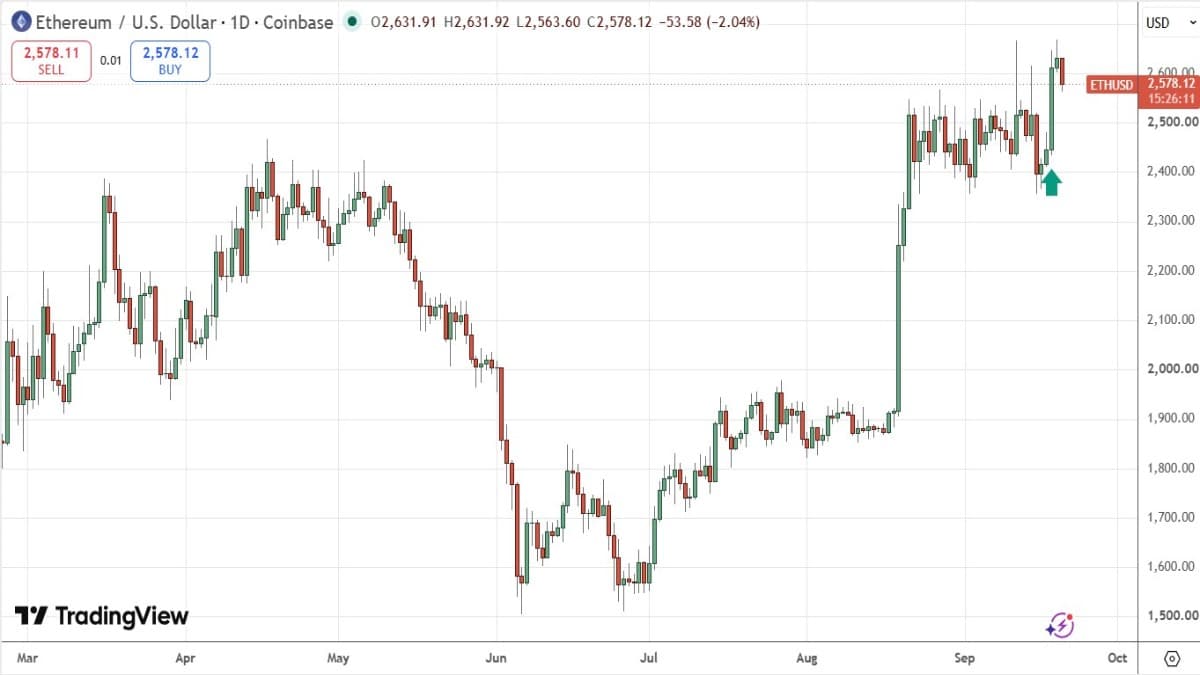
So, Ethereum is looking unusually interesting, as it made a bullish consolidation that was quite narrow for over two weeks, before finally making a strong bullish breakout last Friday, which was a signal to trend traders to enter long. Of course, the price is a bit below that now (crypto has weekend trading).
Crypto has struggled to sustain rallies amid higher US yields, a more hawkish Federal Reserve, and risk aversion linked to elevated oil prices, even though we do see this bullish breakout here and more elevated prices with Bitcoin and a few other cryptocurrencies.
I like to take long-term bullish breakouts in commodities and cryptocurrencies, so I will be going long of Ethereum as soon as I can. I think if the wider market environment becomes more risk-on, we will see Ethereum and Bitcoin shoot higher.
The quality of the breakout from this narrow consolidation looks quite high, and that is another reason to feel more optimistic about this trade. Yet when trading breakouts, you always must be prepared for the possibility of failure, and to use a trailing stop, to achieve long-term success trading this kind of method.
Bottom Line
I see the best trades this week as:
Long of Soybeans.
Long of Ethereum.
Ready to trade our Forex weekly forecast? Check out our list of the top Forex brokers.