


Top Regulated Brokers
The US dollar has found itself in an unusual position: strengthening against the Canadian dollar even as both central banks face mounting pressure to ease rates. That divergence signals deeper structural tension between trade policy shock and carry-trade momentum, creating genuine uncertainty about whether the pair breaks through key resistance or reverses.
Why This Matters Now
The USD/CAD trade hinges on two unresolved catalysts: first, the tariff negotiation timeline between the US and Canada, which has no set resolution date and shows signs of prolonging beyond consensus expectations; second, the divergence between Fed rate expectations and BoC easing commitments, which shifts capital flows strongly in favor of greenback carry-trade positioning. That second dynamic masks a vulnerability: if trade tensions ease suddenly, carry-trade unwinding could trigger sharp CAD strength and USD/CAD reversal. Meanwhile, stronger Canadian economic data relative to the US compounds institutional doubt about the greenback's fundamental merit, yet tariff headlines keep overshadowing that reality.
Technical Structures and Institutional Commitment
The 200-day EMA near 1.38 represents a critical battleground where carry-trade positioning confronts technical resistance. Institutional traders have built considerable long-USD positions on the assumption that tariff friction persists and BoC easing accelerates, anchoring the pair above 1.37. Volume analysis suggests that breakouts above 1.38 have faced recurring seller interest, indicating incomplete institutional conviction despite headlines favoring USD strength. A decisive three-day close above 1.3850 would signal renewed carry-trade commitment; failure to hold above 1.38 would suggest that technical sellers or short-term profit-taking is reasserting control.
USD/CAD remains trapped below the 200-day EMA near 1.38 as tariff headlines collide with carry-trade positioning and divergent central bank rate expectations. The pair's next move hinges on trade negotiation developments and BoC policy signals - neither showing resolution clarity. Watch early North American sessions for negotiation headlines; any substantive deal announcement will test institutional conviction above 1.38, while BoC easing language could spark sharp CAD strength and reverse the carry-trade advantage entirely.
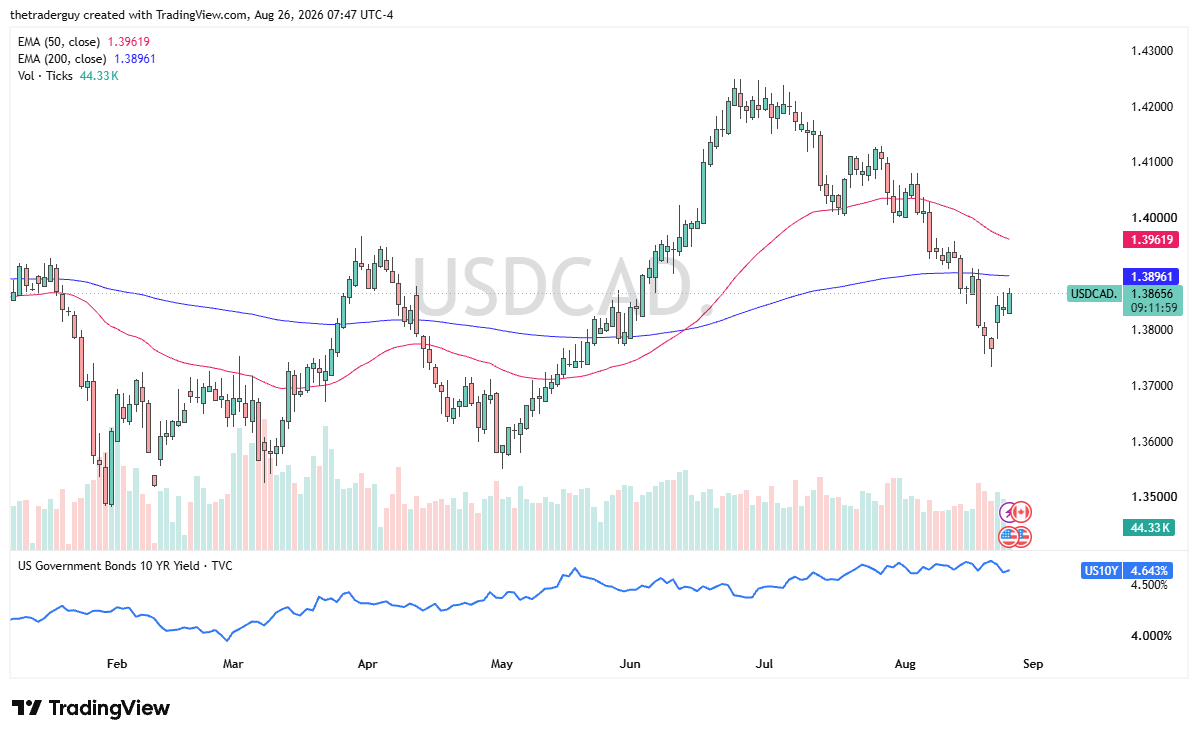
USD/CAD Price Chart
H2 The Consensus Trap: What the Market Is Overlooking
Market consensus currently prices a quick resolution to US-Canada trade tensions, with traders betting that negotiation reopening will ease tariff pressure within weeks. That assumption masks a deeper political vulnerability: Canadian leadership under Mark Carney faces domestic political incentive to maintain a nationalist stance and avoid appearing weak in trade talks, which could extend standoff duration well beyond market expectations. Additionally, US protectionist rhetoric suggests the Trump administration views tariffs as a permanent policy tool rather than temporary negotiating leverage. If prolonged tension becomes the baseline rather than exception, carry-trade unwinding could accelerate sharply, pressuring the greenback precisely when USD long positioning peaks. The market is currently mispricing the probability of extended friction—a divergence that exposes both USD strength and carry-trade positioning to sudden reversal.
H2 When the Thesis Breaks
The USD/CAD strength narrative invalidates in two distinct scenarios. First, should the pair break decisively above the 200-day EMA near 1.38 and hold that level for three consecutive daily closes, it would confirm institutional conviction that trade tensions are fully priced into the pair and carry-trade positioning dominates near-term momentum. Conversely, should USD/CAD reverse below 1.36 and close below that level for two consecutive days while the BoC signals explicit easing commitment in official communications, the thesis of carry-trade-driven greenback strength would lose structural support. A sharp move downward on BoC dovish commentary would indicate that policy divergence—not trade friction—is the primary driver, and that institutional traders are repositioning out of USD longs ahead of rate cuts.
USD/CAD remains trapped below the 200-day EMA near 1.38 as tariff headlines collide with carry-trade positioning and divergent central bank rate expectations. The pair's next move hinges on trade negotiation developments and BoC policy signals—neither showing resolution clarity. Watch early North American sessions for negotiation headlines; any substantive deal announcement will test institutional conviction above 1.38, while BoC easing language could spark sharp CAD strength and reverse the carry-trade advantage entirely.
Ready to trade our USD/CAD analysis? Here is our list of the top 10 brokers worth checking out.