


The euro has a habit of looking like it is about to move, and then not moving at all. Every attempt to break away from its recent range fades almost as quickly as it starts, leaving traders guessing whether anything has genuinely changed beneath the surface. That kind of hesitation can say more than a clean breakout in either direction ever could. It suggests the market is not quite ready to commit, even as the underlying story keeps shifting around it. Whether that changes soon, or simply continues, remains the real question worth watching.
Top Regulated Brokers
Rate Expectations and Middle East Talks Point to Fresh Uncertainty
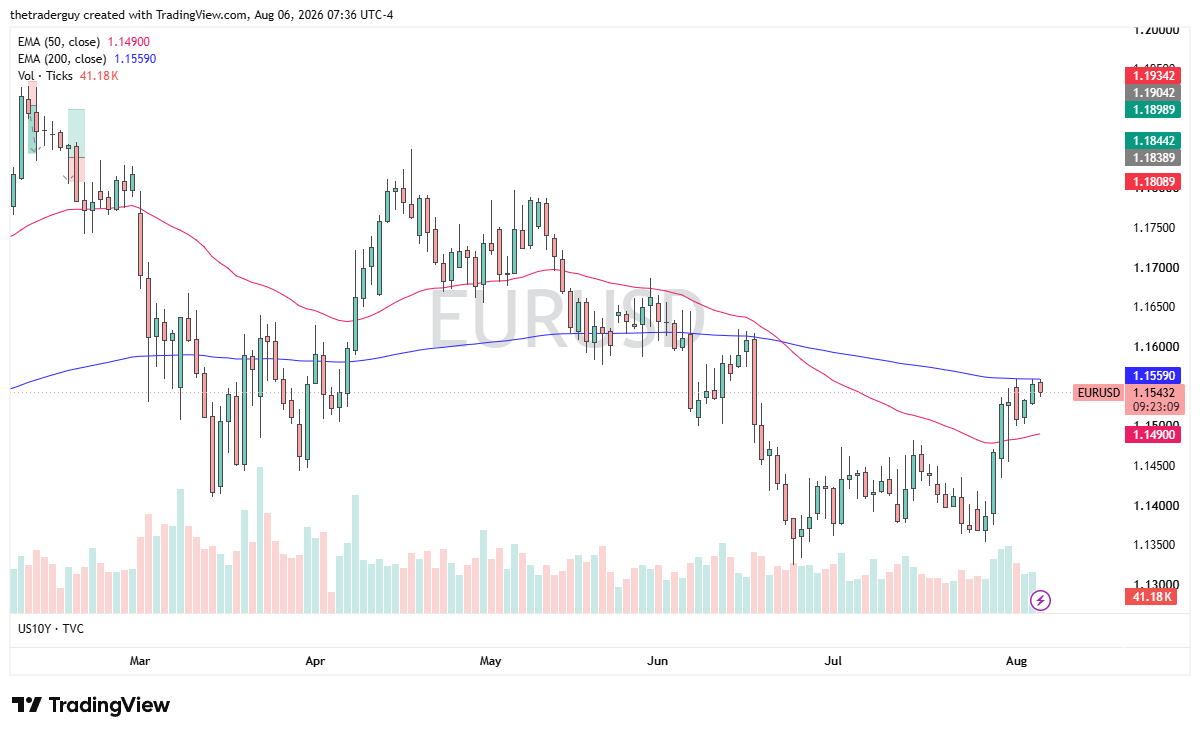
The euro has been pressing against its 200-day EMA this week, with traders leaning into a bit of consolidation right around that major moving average. Ultimately, this looks like a modest relief rally, and it may be getting a lift from the possibility of another round of talks tied to the Persian Gulf conflict. That said, this has been a moving target before, and earlier rounds of optimism have ended in disappointment, so it would not be a surprise if the market is simply confused at this point.
More broadly, this remains a market that stays noisy and tends to take its cues from risk appetite lately. The overall interest rate differential still favors the United States, but traders are increasingly pricing in the idea that the Federal Reserve may eventually need to loosen policy. That shift follows a run of soft US data, at least until the manufacturing PMI numbers came in and complicated the picture.
Technical Levels Show Where Momentum Still Faces a Test
This is a market that appears to be trying to recapture the broader consolidation range it had settled into for a while. The 1.14 level marked the bottom of that range, while 1.1850 marked the top, and the real question now is whether there is enough momentum to push back toward the upper end. The 200-day EMA remains the level most traders are watching, though it is worth noting that it has been flat for quite some time. That flatness points to a lack of longer-term conviction, but given everything else going on at once, that is hardly surprising.
For now, price still reflects a market testing both edges of that range without fully committing to either one. Every push toward the top of the range seems to require a little more effort than the last, and every dip toward the bottom seems to find buyers just as quickly. That kind of back-and-forth rhythm, repeated often enough, is usually a sign that the bigger decision is still being deferred rather than made.
A Flat Moving Average Suggests Deeper Hesitation Than It Appears
It would be easy to read the flat moving average and quiet consolidation as a sign that nothing much is happening, but that calm may be masking more hesitation than complacency. The pair still appears to be trying to recover, yet there is so much uncertainty in play that it remains difficult to get aggressive in either direction. That is arguably the bigger blind spot here: traders leaning on a flat, unremarkable indicator may be underestimating how quickly sentiment could turn if the current relief rally loses its footing.
The risk is not that the market is wrong about the range holding, but that it may be too comfortable assuming the range will keep holding simply because it has so far. Consolidation this stubborn tends to eventually resolve itself, and the longer it drags on without a clear catalyst, the more room there is for a move that catches the more complacent side of the market off guard.
What Could Still Shift the Balance for the Euro
The alternative scenario is straightforward enough. Another shock could send traders back into the US dollar for protection, or a jump in American rates could produce a similar effect. In either case, the pair could retest its recent lows, and a break lower is not out of the question. That balance is worth keeping in mind before assuming the recent bounce reflects a genuine change in direction, since it would not take much to flip the narrative back toward dollar strength rather than euro recovery.
Much of what happens next will likely hinge on the broader risk appetite picture, and on whatever headlines continue to come out of the Middle East. Traders increasingly appear focused on short-term moves rather than any longer-term trend, and the sideways pattern this pair has shown looks likely to continue for now. If that holds, headline-driven, short-term positioning may remain the dominant theme, with no clear trend yet in sight, just more of the same consolidation.
Ready to trade our EUR/USD analysis? Here is our list of the best brokers worth reviewing.