


The Aussie dollar (AUD/USD) continues to consolidate in early trade on Friday as market participants digest tame U.S. inflation data this week that has eased expectations of a September interest rate hike. However, traders appear reluctant to bid up risk-on currencies amid ongoing uncertainty in the Middle East that sees oil prices hoovering just below their August high.
Softer U.S. Inflation Supports AUD/USD While Middle East Tensions Remain
The (AUD/USD) met Thursday’s tamer-than-expected producer price index (PPI) data with a muted reaction. The report from the U.S. Labor Department showed producer prices remaining unchanged in July, boosting expectations that the Federal Reserve will keep its benchmark interest rate unchanged next month. These numbers followed mild consumer inflation readings on Wednesday revealing that core CPI rose 0.2% in July, taking the annual rate to 2.5%, also lowering September rate hike concerns. Following this week’s inflation data, market participants now except a 35% chance of an interest rate increase next month, down from around 50% at the start of the week.
Softer than anticipated U.S. inflationary pressures typically weaken the Greenback and subsequently strengthen the Aussie dollar as rate hike bets fade. However, traders appear reluctant to bid the AUD/USD higher amid a fragile risk-on environment. Despite ongoing negotiations between Washington and Tehran to end the near 6-month conflict, oil prices trade just below their August high, with the Strait of Hormuz—a key waterway in which 25% of the world’s seaborn oil trade transits—remaining a key sticking point in discussions. Higher oil prices raise concerns about global inflation and economic growth prospects, pressuring risk-on currencies like the Aussie dollar.
What the 1-Hour AUD/USD Chart Shows Traders
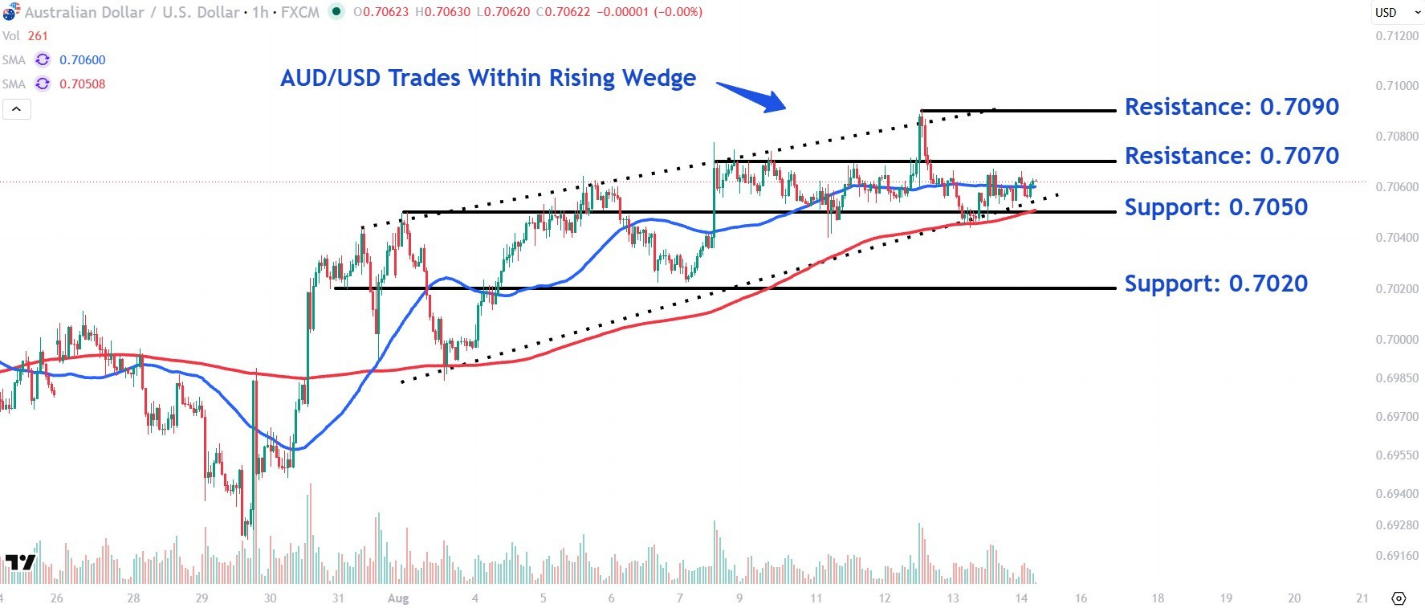
The Aussie dollar has oscillated within an orderly rising wedge since late July, helping establish important support and resistance levels. More recently, the pair found buying interest near the pattern’s lower trendline and closely-watched 200 MA to suggest possible accumulation by larger market participants. Still, recent price action remains lackluster, possibly indicating that traders are waiting for a decisive breakout or breakdown from the rising wedge before taking new positions.
Key AUD/USD Support Levels Worth Watching
The first lower level worth closely watching sits around 0.7050. This location on the chart finds a confluence of support from the rising wedge pattern’s lower trendline, the 200 MA and several notable peaks and troughs stretching back to early August.
A convincing breakdown below this important level could set the stage for a larger decline toward 0.7020. Traders who were waiting for a deeper retracement may seek entry points in this region near a horizontal trendline that connects the August 7 swing low with a brief reactionary pullback in late July.
Key AUD/USD Resistance Levels Worth Watching
If the Aussie dollar continues to push higher from current levels, it’s worth watching how the price reacts to the 0.7070 area. Traders who accumulated long positions near the rising wedge pattern’s lower trendline and 200 MA could set take-profit orders in this location around the Aug. 7 and Aug. 10 peaks.
A close above this price opens the door for a retest of the vital 0.7090 level. This area could encounter overhead selling pressure near the rising wedge pattern’s upper trendline and this week’s high, which also marks the pair’s highest trading point since mid-June.
Where Could the AUD/USD Head Next?
Given the pair’s resilience defending the rising wedge pattern’s lower trendline and rising 200 MA, the price remains well placed to test higher levels, boosted by tame U.S. inflation data reducing interest rate expectations. However, a sudden spike in oil prices driven by a flair up in geopolitical tensions could promptly sour risk-on sentiment, putting downward pressure on the AUD/USD in the process.
Ready to trade our analysis of the AUD/USD? Here is our list of the best Forex brokers worth checking out.