


Top Regulated Brokers
BTC and ETH Hold Steady While the Market Splits
As is often the case during crypto winters, the digital asset market spent the week pulling in different directions. Bitcoin (BTC) and Ether (ETH) stayed close to where they started, while the broader field broke into two nearly equal halves: assets that gained and assets that gave ground. That kind of split is harder to read than a coordinated rally or a broad selloff.
Within that divide, individual assets moved sharply in opposite directions without arranging themselves into an obvious sector story. The distance between the week's strongest and weakest names grew unusually wide. This is a setup to keep an eye on in the week ahead to see how things unfold.
As of Saturday evening, the total crypto market cap sat near $2.25 trillion, with Bitcoin dominance holding steady near 58.6%, showing capital did not rotate broadly away from King Crypto over the past week. Altcoins traded mixed, with isolated strength instead of a broad breakout, including a 30% weekly gain for Shiba Inu (SHIB), and a 40% surge for Audiera (BEAT).
The BTC/USD chart shows the malaise that gripped most of the market. After closing last Saturday at $64,791, Bitcoin climbed as high as $66,965, lit a low of $63,652, and at the time of writing, trades at $64,484, for a decline of 0.15% on the 7-day chart.
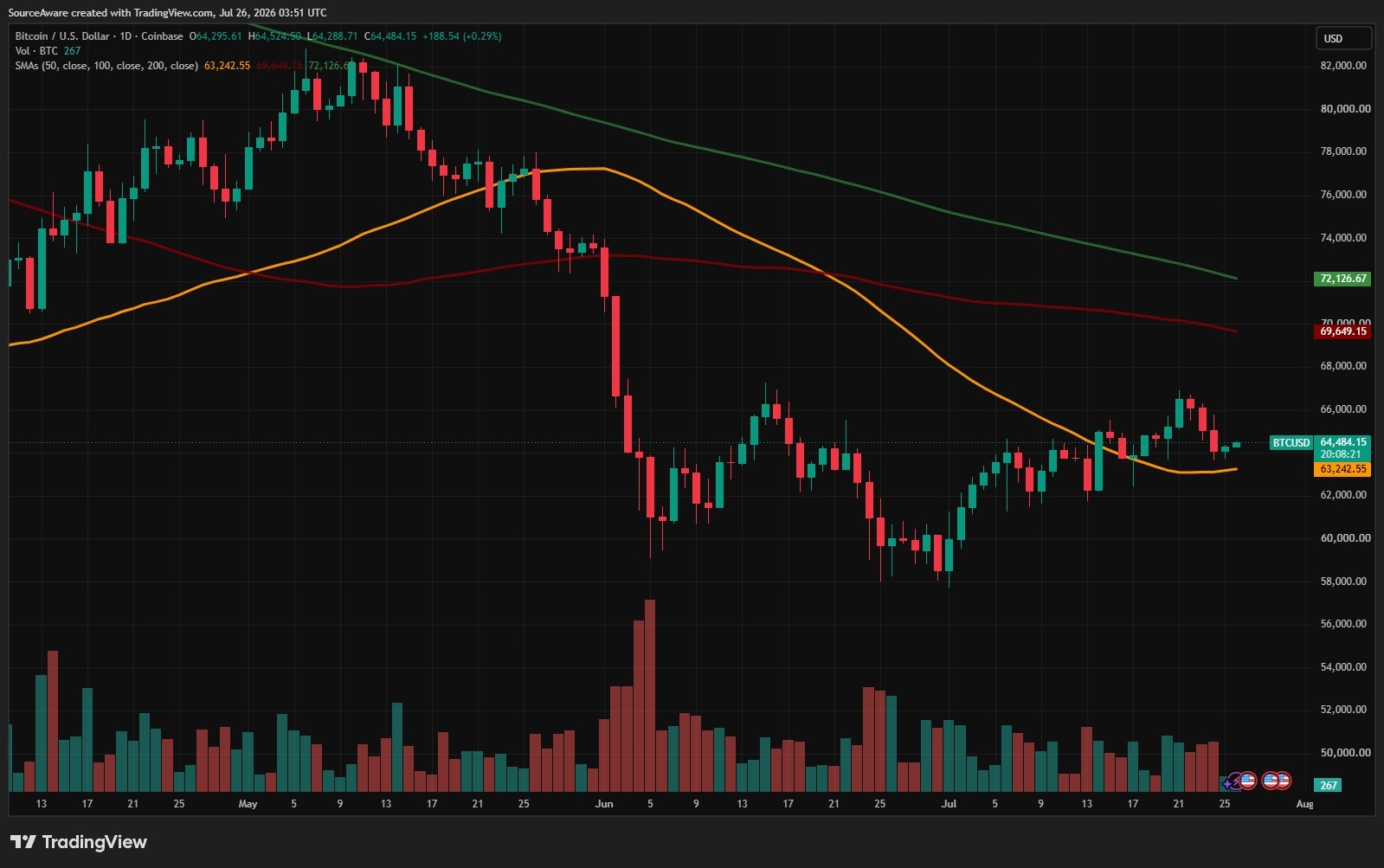
BTC/USD 1-day chart. Source: TradingView
The brief rally higher sparked hope for many that BTC could soon climb back above the short-term-holder cost basis Glassnode has identified near $69,000. Yet the failure to even break above $67,000 brought people back down to reality, resulting in its price drifting back toward the provider's $63,000 on-chain demand shelf.
On the ETF front, there were seven positive U.S. spot Bitcoin ETF sessions from July 14 through July 22, totaling $999.3 million. Outflows of $225.1 million on July 23 and $240.1 million on July 24 then cut that run by $465.2 million. Overall, the period saw a net positive of $534.1 million, suggesting some accumulation is still happening, but nothing to brag about, historically speaking.
Meanwhile, Ethereum closed last Saturday at $1,863, made a run at resistance at $2,000 but got stopped short at $1,955, and currently trades at $1,880 for a 7-day increase of 0.91%.
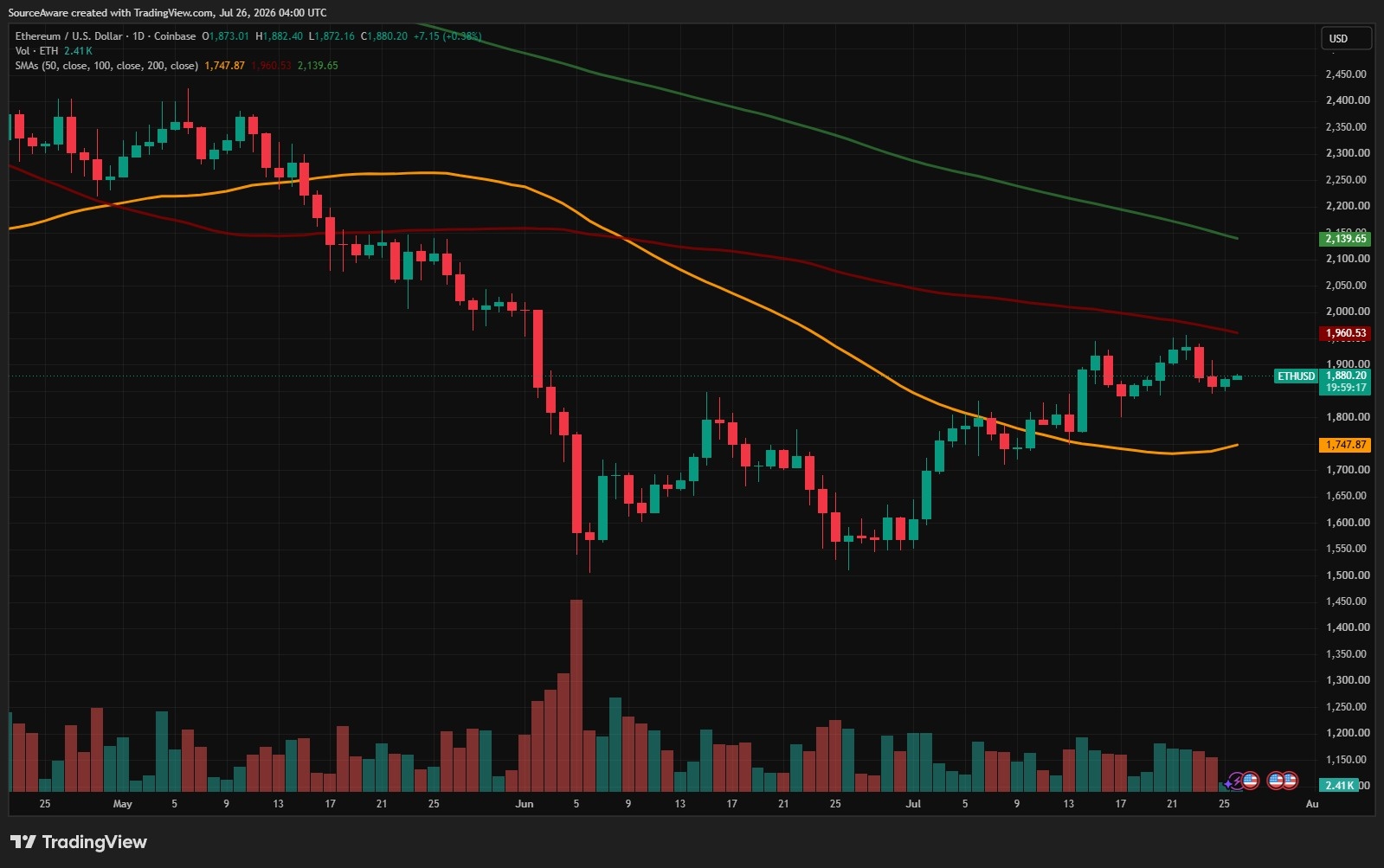
ETH/USD 1-day chart. Source: TradingView
During the period from July 14 through July 24, U.S. listed spot Ether ETFs experienced a net inflow of 224.7 million, also showing that amid the crypto winter blues, there remains a cohort of investors that continue to increase their exposure.
Privacy Coins Show a Wide Split: XMR vs ZEC
Looking at the broader market, many traders found it difficult to make heads or tails of where things are headed, with the widest top 100 spread appearing between two assets that investors often lump together: Monero (XMR) and Zcash (ZEC).
Monero gained roughly 8.2% over the seven-day window. Zcash dropped roughly 13.5% over the same period. More than 21 percentage points of separation inside what many traders treat as a single privacy trade broke the lazy sector story before it could form.
Taking a closer look at the charts shows that Monero sat near $362 at the Saturday snapshot, with a reported 24-hour volume of approximately $122 million.
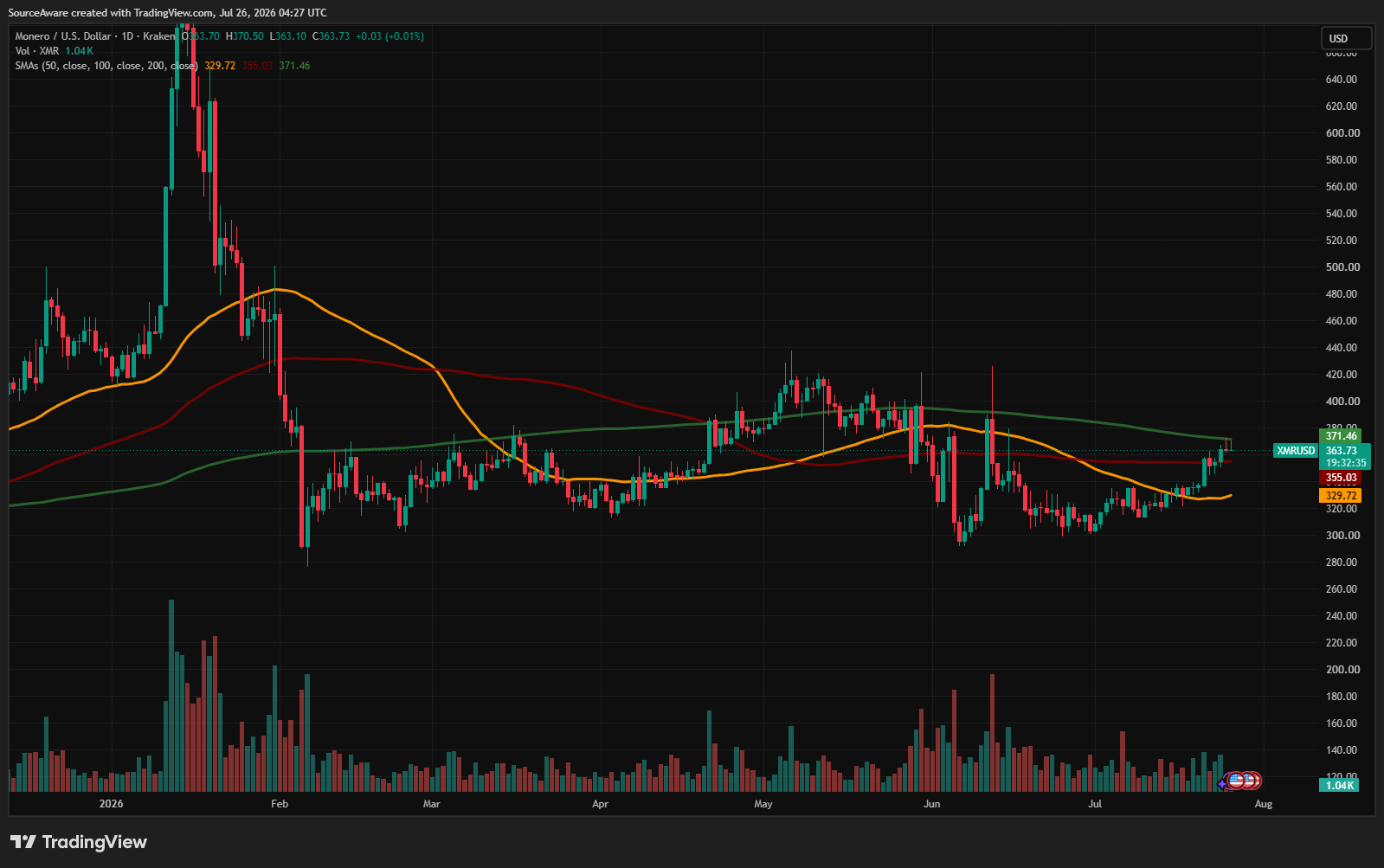
XMR/USD 1-day chart. Source: TradingView
The seven-day gain of roughly 8.2% placed it among the clearest outperformers in the top 100 during a week when the benchmark barely moved. The same data does not identify a catalyst, and without separate primary evidence pointing to one, the evidence ends at price and volume. Relative strength of that magnitude in a flat market environment is worth noting on its own terms, without requiring a narrative to explain it.
On the opposite side of the spectrum was Zcash, dropping roughly 13.5% over the same seven-day window to near $485 at the Saturday snapshot, with reported 24-hour volume near $157 million.
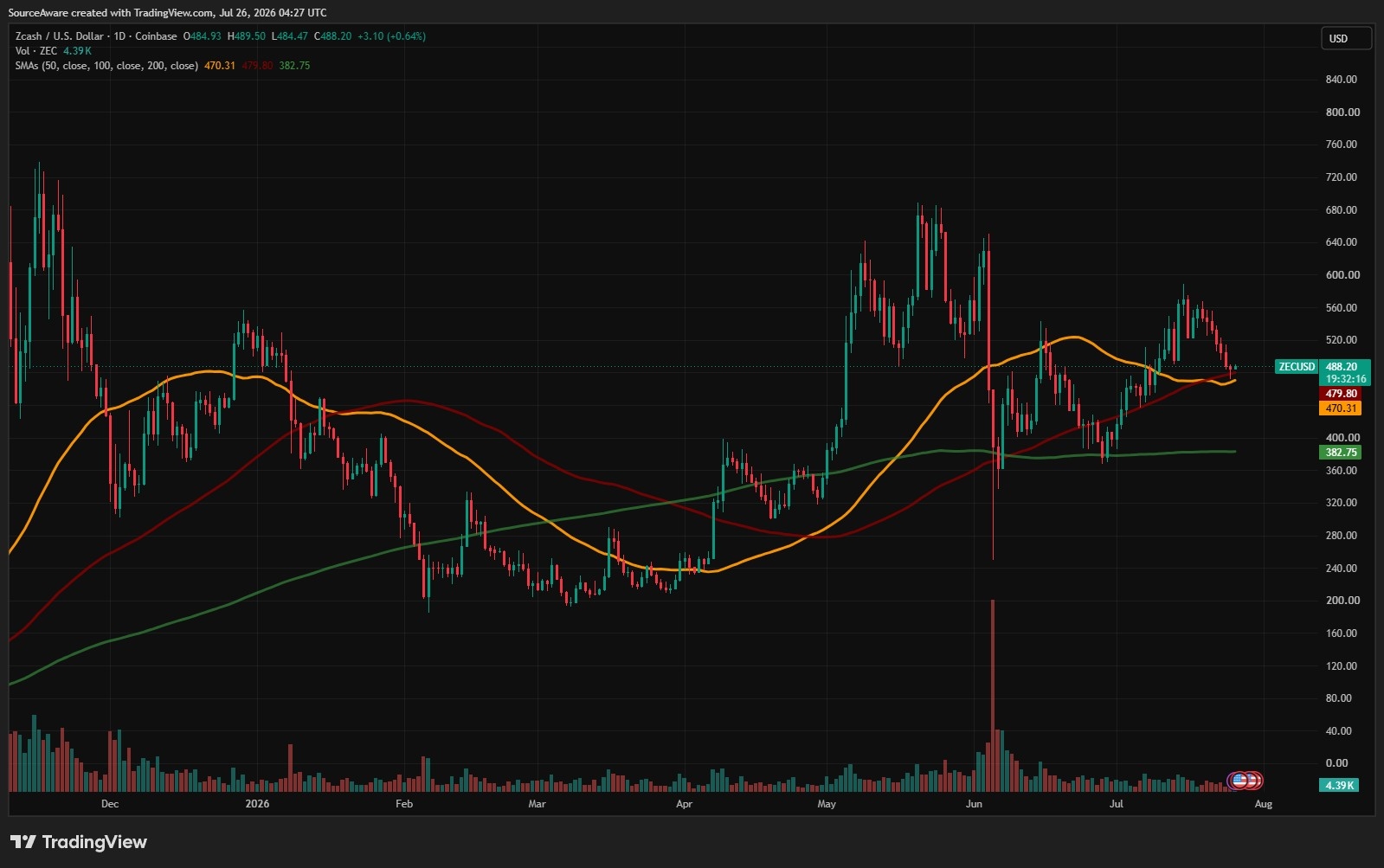
ZEC/USD 1-day chart. Source: TradingView
This divergence has many traders perplexed. Two assets that share a category label and a rough market-cap tier moved more than 21 percentage points apart in one week. Price data does not explain that gap. The divergence breaks the assumption that a shared label means a shared story, and it pushes back on any read of the privacy-asset space as a unified trade.
The breadth split is easy to misread. Forty-nine gainers could look like the early stages of a broader advance. Fifty-one decliners could look like the market rolling over. Neither reading holds cleanly when movement is concentrated in specific names and the benchmark finished near flat.
Bitcoin dominance near 59% is the part that complicates the bull interpretation most directly. High dominance alongside nearly even breadth means the advance remained narrow. Bitcoin held its share while the rest of the market split. Leadership stayed scattered, which makes the setup harder to use from a trend-following perspective.
Bitcoin and Ether ETF Flows Send Mixed Signals
The two-day ETF outflow of $465.2 million following seven positive sessions adds another layer to the picture. The July 14 through July 24 window remained net positive overall, but the reversal narrows that margin and introduces a question about whether institutional demand can absorb another week of mixed price action.
Fed Meeting and Rates Add External Pressure
The Federal Reserve's July 28 through July 29 meeting adds external pressure to the setup. The Fed held its target range at 3.5% to 3.75% in June and noted that inflation remained elevated. Any shift in rate expectations from that meeting could move risk appetite, yields, and dollar positioning in ways that affect crypto markets regardless of what on-chain data or ETF flows do in isolation.
Two Paths Ahead for Crypto: Consolidation or Distribution?
All eyes will be on the Monday open, and the divided picture could tighten up from here. If Bitcoin holds the modeled $63,000 demand shelf and ETF flows stabilize after last week's reversal, the week's flatness could look more like consolidation than distribution. A broader advance would need more assets to join the move, with spot volumes improving across the market and dominance beginning to ease rather than hold.
The bearish read has its own conditions. Renewed ETF outflows, another week of slightly negative breadth with no improvement, and a sustained loss of the BTC demand zone would suggest the week's selective gains lacked depth.
XMR and ZEC will act as a dispersion check going into the next period. If that gap narrows, it points to position unwinding on one side; if it holds or widens, the rotation story gets more complicated rather than more legible.
For now, the market enters the new week divided, with a benchmark that barely moved and assets spread across widely different outcomes. The FOMC meeting will test whether rate expectations move the broader risk environment around crypto. BTC's $63,000 shelf and the gap between XMR and ZEC all carry unresolved information into the coming sessions.
Whether this week's split resolves into something cleaner or stays selective and uneven is the read to bring into next Sunday.
Ready to trade our analysis of the crypto market? Here’s our list of the best MT4 crypto brokers worth reviewing.