


Top Regulated Brokers
Bitcoin (BTC) spent the past week struggling to reclaim the $60,000 level as traders weighed a weaker technical setup, a firmer U.S. dollar, and one of the most important sentiment shifts in the corporate Bitcoin story: Strategy has formally opened the door to selling some of its Bitcoin holdings.
Data provided by TradingView shows that BTC has been trading in a narrow range near $59,000 to $60,500 after last week’s decline pushed the top crypto below the psychologically important $60,000 threshold.
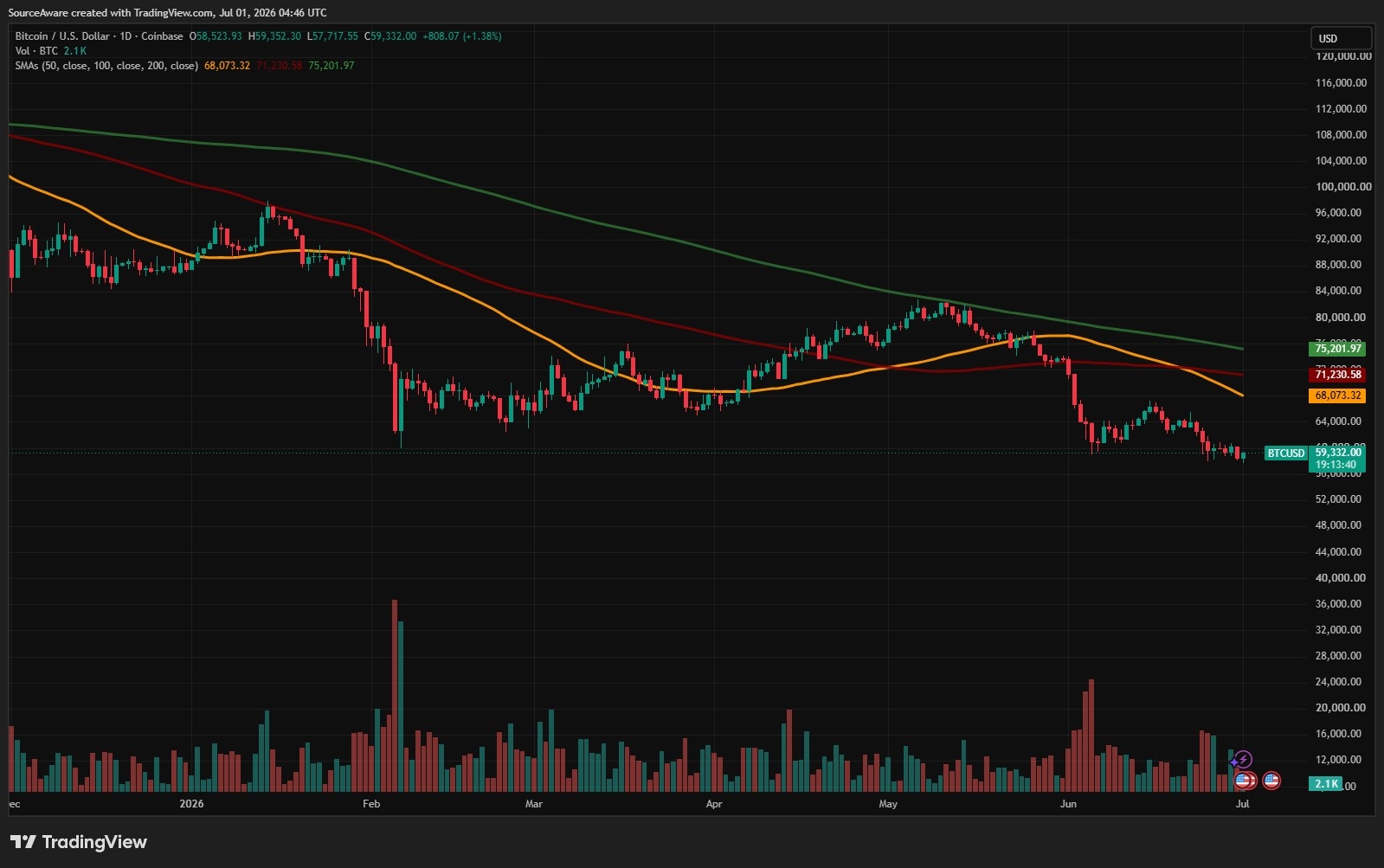
BTC/USD 1-day chart. Source: TradingView
While falling below $60,000 negatively impacted sentiment, the larger concern is that the recent consolidation is occurring after a decline, rather than after a strong upwards move. That makes the current range feel less like a healthy pause and more like a market waiting for a catalyst.
Bulls want to see BTC recover $60,000 with conviction, then push back toward the $62,000 to $63,000 region that previously acted as support. Bears, meanwhile, are watching whether repeated failures near $60,000 lead to exhaustion and another leg lower. If buyers cannot defend the upper-$50,000 zone, the next debate will quickly shift toward whether BTC needs a deeper flush before a durable bottom can form.
At the time of writing, Bitcoin trades near $59,332, a decline of 5.5% over the past 7-days.
Strategy Changes the Bitcoin Narrative
For years, Strategy, formerly MicroStrategy, was the cleanest corporate expression of the Bitcoin treasury thesis. Michael Saylor’s message was simple and memorable: accumulate Bitcoin and do not sell it. That posture helped turn Strategy into a proxy for institutional Bitcoin conviction, especially before spot Bitcoin ETFs gave investors a more direct route.
That is why this week’s capital framework matters. Strategy announced a Digital Credit Capital Framework that includes a Bitcoin monetization program, allowing the company to sell up to $1.25 billion worth of BTC to build or replenish its U.S. dollar reserve, cover preferred dividend and interest obligations, and support buyback programs when management decides that selling Bitcoin is more attractive than issuing equity.
The company has emphasized that the authorization does not require it to sell Bitcoin. It also remains committed to Bitcoin as its primary treasury reserve asset. Still, the market does not trade only on technical definitions. It trades on narrative, and the narrative has changed. Strategy is no longer only seen as a one-way accumulator. It is now also a potential source of supply.
That does not mean the company is abandoning Bitcoin. In one sense, the move could be interpreted as more mature capital management. A company with large preferred obligations, stock-price pressure, and a massive Bitcoin balance sheet needs flexibility. For traders, the emotional effect is harder to ignore. When the loudest corporate “never sell” story becomes a “sell when strategically useful” story, it removes one of the market’s simplest bullish symbols.
Bitcoin’s Digital Gold Problem
There has been another notable shift in the larger narrative. Bitcoin is often described as digital gold, and that comparison still has merit over long time horizons. It has a fixed supply, no central issuer, and a monetary premium that appeals to investors worried about fiat debasement.
But in the current market, BTC is not acting like a clean safe-haven asset. It is acting more like a high-beta liquidity asset.
That means Bitcoin tends to perform well when liquidity is abundant, risk appetite is strong, and investors are comfortable moving out on the risk curve. When the U.S. dollar strengthens, leverage gets reduced, or macro uncertainty rises, BTC can sell off quickly alongside equities and other speculative assets.
This is where the Japanese yen comparison becomes useful. The yen has long been used as a funding currency for global risk-taking. Investors borrow cheaply in yen, sell yen, and buy higher-return assets elsewhere. When that carry trade is working, it supports risk appetite. When it unwinds, traders buy yen back and sell the assets they previously funded.
Bitcoin is not the yen. It is not a funding currency in the same institutional sense. However, it may be one of the clearest crypto-market expressions of the same global liquidity cycle. The yen funds risk. Bitcoin reflects the appetite for that risk.
For crypto traders, this is the useful takeaway: if Bitcoin is trading as a high-beta liquidity asset, macro funding conditions matter a great deal.
My Take on Bitcoin and Strategy
Bitcoin’s current setup is less about one headline and more about a cluster of pressure points arriving at the same time. BTC is struggling to reclaim $60,000, Strategy’s “never sell” era has been replaced by a more flexible capital-management framework, and the macro backdrop is not clearly supportive for high-beta assets.
The bullish case is not dead. Strategy has not abandoned Bitcoin, and the ability to manage reserves may help the company survive a prolonged downturn. A strong reclaim of $60,000, improving ETF demand, and calmer macro conditions would quickly reduce the bearish overhang.
But the market now must absorb a more complicated reality. Bitcoin is still scarce, still institutionally relevant, and still the center of the crypto market. Yet in the short term, it is trading less like untouchable digital gold and more like a liquidity-sensitive risk asset.
That makes the next move around $60,000 important. A clean recovery would suggest the market has digested the Strategy news. Continued weakness would suggest traders are still repricing what happens when Bitcoin’s most famous corporate holder becomes willing to sell.
Ready to trade our analysis of Bitcoin and Strategy? Here’s our list of the best MT4 crypto brokers worth reviewing.