





Bitcoin (BTC) has been under significant selling pressure in February, reflecting broader market anxieties driven by economic headwinds, tariff tensions, and geopolitical risks.
Data provided by TradingView shows that King Crypto is now down more than 48% from its October all-time high, trading near $65,500 after dipping below $63,000 earlier in the trading session.
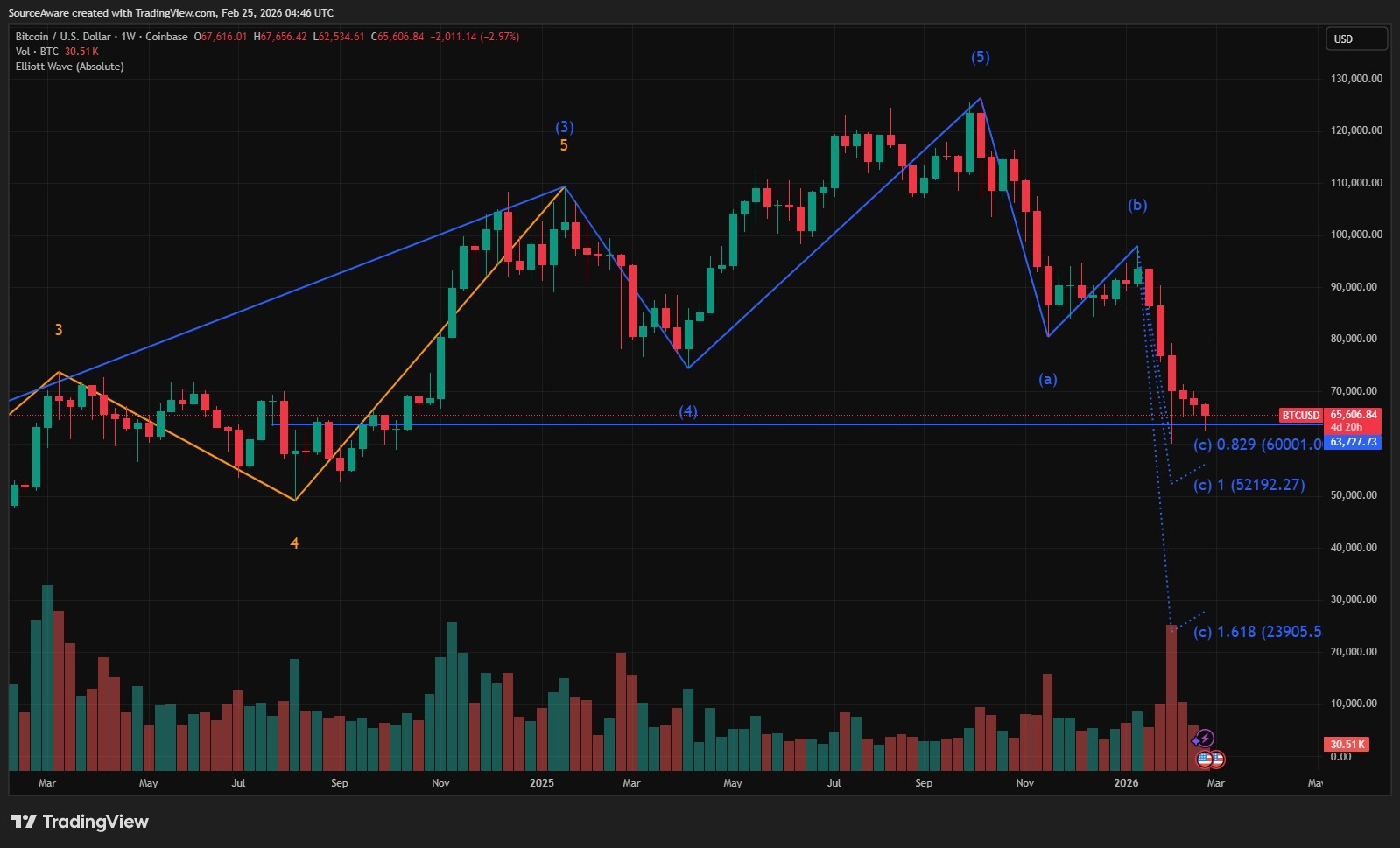
BTC/USD 1-day chart
Its price has recovered slightly from the recent low of $90,000 set on February 6th, but it has a lot of work to do before it gets back to its winning ways and helps lift sentiment in the crypto market, which is currently registered as an 11 on the Fear & Greed Index, putting it in Extreme Fear territory.
And things could get worse before they get better, with prediction markets pricing a 42% chance of Bitcoin falling below $60,000 before February ends, amid accelerating capital outflows. Traders are eyeing support clusters in the low $60,000s as a potential bounce zone, but a break lower could target $50,000 or even $47,000 based on historical volume nodes.
Zooming out to the macro picture, this downturn aligns with a broader risk-off environment, where U.S. stocks and other cryptos have also faced pressure, exacerbating Bitcoin's beta-driven moves.
As for when the crypto winter will end, analyst projections vary, but many suggest the downturn is in its later stages, with a potential bottom forming soon.
Among the more hopeful are Compass Point analysts, who indicate the crypto bear is in its "final innings," forecasting a floor between $60,000 and $68,000, supported by long-term buying. Bernstein also maintains a bullish long-term view, calling the current selloff the "weakest bear case in history" and reaffirming a $150,000 target by end-2026.
However, more conservative voices, like Benjamin Cowen, warn that any near-term bounce may be temporary, with the cycle potentially not bottoming until October 2026. Others anticipate a prolonged stagnation until Q3 2026, though holding above $60,000 could signal a Wyckoff-style accumulation phase leading to upside in Q2.
Overall, while short-term risks persist, institutional inflows and historical patterns point to recovery by late 2026, potentially driven by easing macro conditions. At the time of writing, Bitcoin trades at $65,458, a decline of 3.3% on the 7-day chart.
Canton: A Beacon of Institutional Strength in the Crypto Winter
Amid the red across the market, the Canton Network (CC) has emerged as a resilient player. Directly appealing to the Wall Street crowd, Canton is designed as a privacy-enabled Layer 1 blockchain for institutional finance and real-world asset (RWA) tokenization.
Launched in May 2023 by Digital Asset Holdings and a consortium of banks, Canton enables secure, interoperable connections across financial systems while preserving data privacy through configurable controls. Its native utility token, CC (Canton Coin), powers network fees, rewards stakeholders for real usage, and aligns incentives for builders, users, and operators via a "burn-mint equilibrium" model that burns ~2.5 billion tokens annually.
While the broader market has been in freefall, CC has held up strongly, continuing to trade near $0.16 after hitting an all-time high of $0.195 on February 3rd.
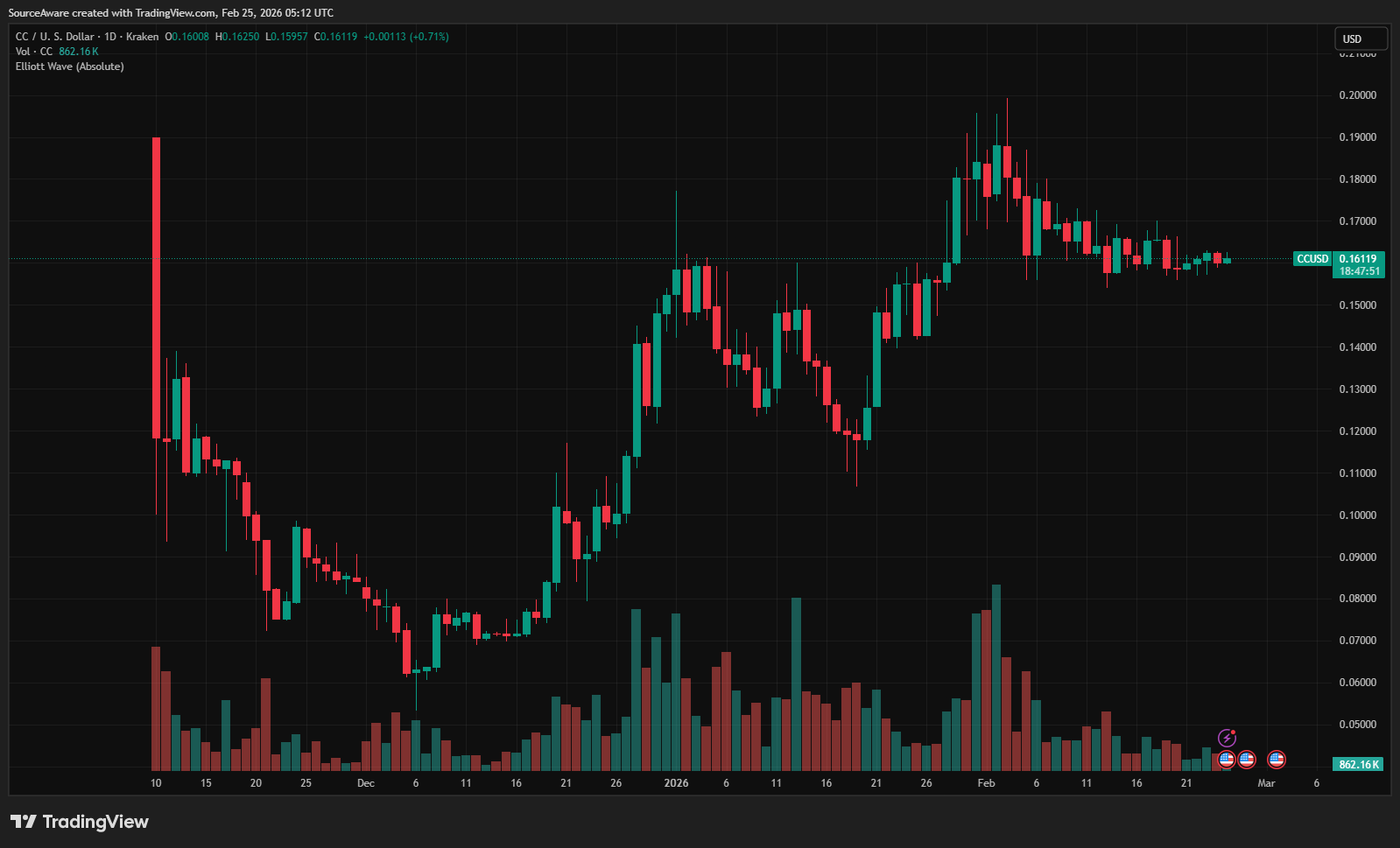
CC/USD 1-day chart
The chart shows that Canton has demonstrated resilience, outperforming the market with a $6.1 billion market cap, ranking 14th among cryptos, and daily volumes exceeding $8 million.
The support for the CC price has largely been driven by institutional demand and deflationary burns, with 15 million tokens destroyed daily, equating to 14% of its market cap annually. The platform boasts institutional-grade features that are luring big money on-chain, including privacy for regulated entities, seamless RWA integration, and partnerships that bridge TradFi and blockchain.
Key collaborations include DTCC's initiative to tokenize DTC-custodied U.S. Treasury securities on Canton, enabling on-chain liquidity for over $100 trillion in assets, with an MVP planned for H1 2026. JPMorgan is also involved in the project, deploying its JPM Coin on the network and extending institutional payments.
In total, Canton is backed by over 600 institutions – including Goldman Sachs, BNP Paribas, and BNY Mellon – and manages $6 trillion in tokenized assets. It is positioned for exponential growth in a $10 trillion RWA market by 2030, as the tokenization revolution heats up.
Overall, CC’s focus on real utility insulates it from retail-driven crashes, making it a strong, defensive pick for portfolios eyeing long-term TradFi adoption. At the time of writing, CC trades at $0.162, a decrease of 2.5% on the 7-day chart.